Concrete Takeoff Software
Measure slab areas, footing runs, grade beams, and pier locations from structural and foundation plans. Apply built-in material templates for automatic volume and rebar calculations. Group by pour phase and export material quantities. $39 a month, with annual at $399.
Concrete Takeoffs, Simplified
A concrete takeoff converts plan-view areas and linear runs into cubic yards, formwork board feet, rebar weight, and accessory counts. A 30 by 40 slab at 4 inches deep is 14.8 cubic yards before waste; the same slab at 6 inches is 22.2. A short pour is the most expensive mistake in concrete. When the last truck dumps and the slab is three yards short, you are looking at a cold joint, $150 per yard for a short-load delivery, and $2 to $4 per minute in standby charges while the batch plant mixes and dispatches. On a 40-yard pour, being 3 yards short costs $450 in concrete plus $200 to $400 in pump standby while the crew waits. If you cannot get a truck in time, the cold joint may require saw-cutting and re-pouring at $2,000 or more depending on the structural spec. Over-ordering is less painful but still costs money: unused concrete in the truck gets charged at full price, and you pay for the wash-out. Easy Takeoffs gives concrete contractors a browser-based tool for $39 a month to measure slab areas, footing runs, grade beams, pier locations, and curbs directly from structural and foundation plan PDFs. Try every feature free for 14 days, no credit card. Trace slab outlines with the polygon tool for square footage. Measure footing and grade beam runs with the linear tool. Count pier locations, caisson spots, and anchor bolt embeds. Group measurements by pour phase so each pour has its own material summary. Export to CSV, multiply area by thickness, and convert to cubic yards with one formula: area times depth in feet, divided by 27. Easy Takeoffs includes seven concrete and masonry templates: Concrete Slab, CMU Block Wall, Concrete Foundation Wall, Concrete Strip Footing, Concrete Sidewalk, Concrete Curb & Gutter, and Brick Veneer. Apply a template to any measurement group and it generates a material list with concrete volume, rebar, form lumber, vapor barrier, and accessories. Adjust properties like slab thickness, reinforcement type, or footing size to match your structural plans.
Every Measurement Type
Areas, lines, counts, angles, and true curves, plus symbol search
Snap to Walls & Corners
Cursor locks to lines, corners, midpoints, and edges
Auto Scale Detection
Reads each sheet's scale; one tap confirms, one run sets every page
$39 a month
14-day free trial, no credit card, cancel any time
Any Device
Browser-based on Mac, Windows, tablet, or phone
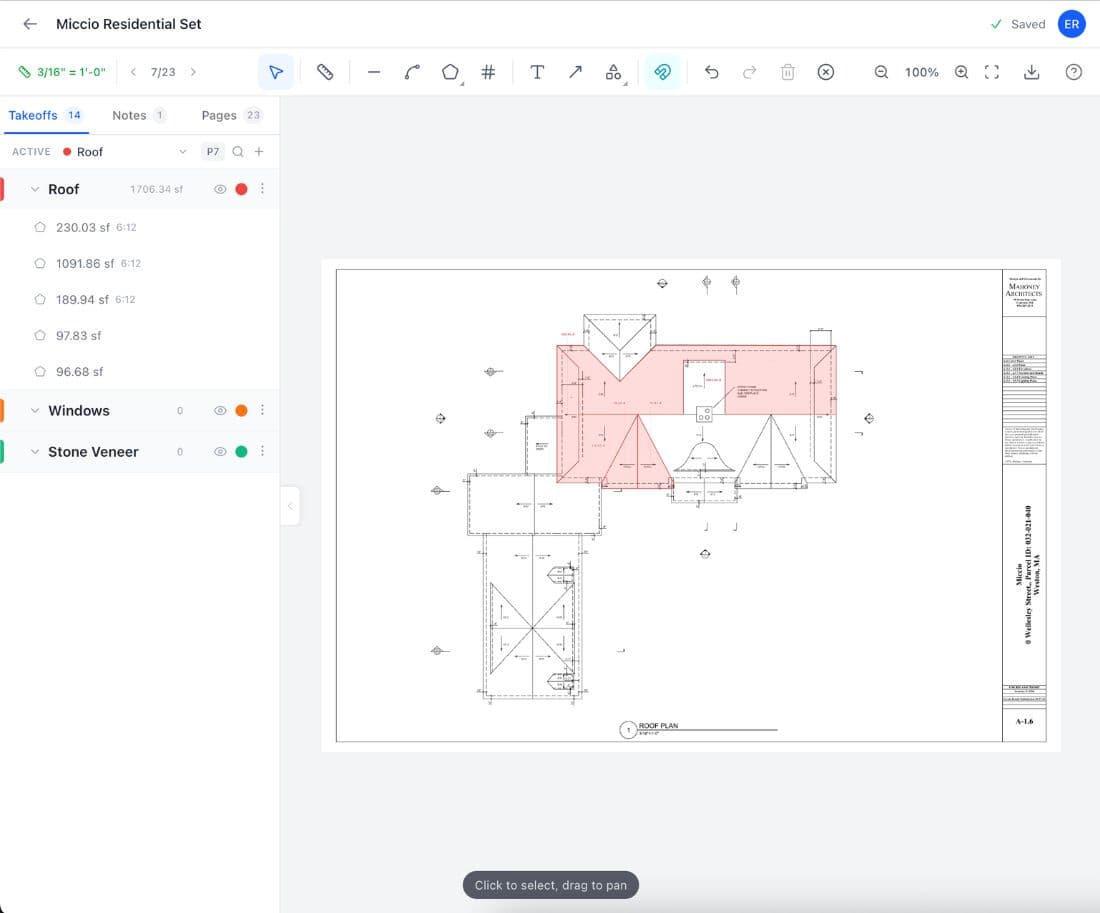
What Is a Concrete Takeoff?
A concrete takeoff is the process of measuring areas, lengths, and counts from structural and foundation drawings to calculate the cubic yards of ready-mix concrete, pounds of rebar, square feet of formwork, and quantities of accessories needed for a project. The core calculation converts two-dimensional measurements from the plans into three-dimensional volume: slab area times thickness, footing length times cross-sectional area, pier count times individual volume. The formula for cubic yards is area in square feet times depth in feet, divided by 27. A 1,200 square foot garage slab at 4 inches thick is 1,200 times 0.333 divided by 27, which equals 14.8 cubic yards before waste. A complete concrete takeoff goes beyond the pour volume. You also measure footing lengths for rebar calculation (linear feet of footing times the number of bars times the bar weight per foot), form contact area for lumber and form tie quantities, vapor barrier area for under-slab moisture protection, and anchor bolt and embed locations from the structural details. Each pour phase gets its own measurement group because concrete is ordered and placed in sequences: footings first, then slab on grade, then elevated decks. Mixing quantities across pour phases creates ordering confusion and risks short pours on the critical path.
How to Do a Concrete Takeoff
Upload structural and foundation plans
Drop your S-sheet PDF plans into Easy Takeoffs. Foundation plans, slab-on-grade layouts, structural framing plans, and detail sheets all live in one project. Navigate between the foundation plan, footing schedules, and structural details using the page selector.
Calibrate scale from column grid or dimension
Set the scale using a column grid spacing (typically 20 to 30 feet on commercial), a known footing dimension, or the printed scale on the sheet. Structural plans commonly use 1/4 inch or 1/8 inch scale. Each sheet can have its own calibration for enlarged details at 3/4 inch or 1 inch scale.
Measure slabs, footings, piers, and embeds
Trace slab outlines with the polygon tool for area in square feet. Measure continuous footing runs, grade beams, and curbs with the linear tool for total footage. Count pier locations, caisson spots, anchor bolt embeds, and hold-down locations. Group every measurement by pour phase: Phase 1 footings, Phase 2 slab, Phase 3 elevated deck.
Export and calculate cubic yards
Set a depth on each slab and footing and the software converts area and footage to cubic yards for you, with the waste factor visible and yours to adjust. The math a batch plant order needs (slab area times thickness, footing length times width times depth, all divided by 27) happens live as you measure. Sum each pour phase total in the sidebar and call in your truck order.
Built for Concrete
Slab area measurement
Trace slab outlines of any shape with the polygon tool. Irregular footprints, step-downs, thickened slab edges, and depressed slabs for tile all measure accurately. A 1,200 square foot garage slab at 4 inches thick is 14.8 cubic yards before waste.
Footing and grade beam lengths
Measure continuous footing runs, spread footing perimeters, grade beam centerlines, and curb and gutter lengths with the linear tool. Each segment displays its individual and cumulative length. A typical residential foundation has 200 to 400 linear feet of continuous footing.
Pier, caisson, and embed counting
Count pier locations, drilled shaft positions, anchor bolt embeds, hold-down locations, and dowel positions. Each count marker sits precisely on the plan where the item appears. Symbol search can return confirmed matches from one boxed example, checked by default for optional review or exclusion before bulk addition. A commercial foundation with 40 piers at 24 inches diameter and 8 feet deep is 25 cubic yards just in piers.
Pour phase grouping
Group measurements by pour sequence: footings first, then slab on grade, then elevated decks. Each group exports with its own area, linear, and count totals. Your batch plant order maps directly to the pour schedule with no quantity sorting after export.
Auto scale detection
Most structural PDFs have the scale printed on the sheet. Easy Takeoffs reads it automatically. When it is missing, calibrate against a column grid line or a dimensioned footing. Foundation details at 3/4 inch scale calibrate separately from the 1/4 inch plan view.
$39 a month, flat
Easy Takeoffs is the cheapest dedicated concrete takeoff tool on the market. PlanSwift costs $2,000 a year per seat. STACK runs $2,988 or more. Bluebeam Revu Complete is $440 a year. Easy Takeoffs is $39 a month or $399 a year, with a 14-day free trial and no credit card. Switching from PlanSwift saves $1,532 per estimator per year on monthly billing.
Built-in Concrete Templates
Apply Concrete Slab, CMU Block Wall, Concrete Foundation Wall, Concrete Strip Footing, Concrete Sidewalk, Concrete Curb & Gutter, or Brick Veneer templates to your measurement groups for automatic material lists. Adjust properties like slab thickness, reinforcement type, rebar spacing, or footing size to match your structural plans.
Check your quantities before you bid
Each one shows the formula and a worked example so you can check the number, not just trust it. Free, no signup. For exact quantities, measure from your plans.
Concrete Calculator
Cubic yards, bags, and cost for slabs, footings, walls, columns, round pads, and stairs.
Open calculator→
Concrete Block Calculator
Blocks, mortar, grout, and rebar for a concrete block wall, plus a 2026 cost estimate.
Open calculator→
Gravel Calculator
Cubic yards and tons of gravel for a driveway, pad, or path, with per-material weight and compaction.
Open calculator→
Concrete Waste Factors
Industry-standard waste percentages for common concrete materials. Apply these to your measured quantities for accurate ordering.
Typical Waste Factors
Formed slabs with clean, level subgrade and tight forms waste 3 to 7 percent. Over-excavation below the slab creates low spots that consume extra volume. Pump truck priming wastes 0.25 to 0.5 cubic yards per pour. Always round up to the nearest half yard when ordering.
Footings poured directly against soil absorb concrete into the trench walls. Irregular soil excavation creates over-wide sections that hold more volume than the plan dimensions. A 12-inch by 24-inch footing trench that averages 14 inches wide adds 17 percent to the calculated volume in that section alone.
Drilled shafts and belled piers often encounter loose soil that collapses the hole diameter beyond the specified size. Caving soil on a 24-inch pier that opens to 28 inches increases volume by 36 percent for that pier. Budget 8 percent overall for typical soil conditions.
Lap splices at 40 to 60 bar diameters add 3 to 5 percent to net length. Development lengths at footing-to-wall transitions, cut waste from standard 20 or 60 foot stock lengths, and bending waste add another 2 to 4 percent. Total weight adds 5 to 8 percent over net calculated.
Standard 5-by-10 foot sheets overlap 6 inches minimum at all edges. On a 1,200 square foot slab, edge overlaps waste 8 to 12 percent of the sheet material. Irregular slab shapes waste more because partial sheets at curved edges cannot be reused.
Single-use form lumber on complex shapes with step-downs and grade changes wastes 10 to 15 percent from cuts. Reusable forms on repetitive work reduce waste to 5 percent, but initial investment is higher. Stakes, bracing, and kickers are typically separate from form board calculations.
Under-slab vapor barrier overlaps 6 to 12 inches at seams and turns up 3 inches at the forms. A 1,200 square foot slab needs roughly 1,300 to 1,400 square feet of poly. Punctures during rebar installation require patch pieces that add another 2 to 3 percent.
Why Concrete Contractors Need Better Takeoffs
A short pour creates a cold joint and a structural problem
You calculated 38 cubic yards for a foundation pour. The last truck dumps at 36 yards and the footings are not full. Now you have a cold joint where fresh concrete meets cured concrete, which may not meet the structural engineer's specification. A short-load delivery to finish costs $150 per yard plus $200 to $400 in pump standby charges while the batch plant mixes and dispatches. If the cold joint fails inspection, you are saw-cutting and re-pouring at $2,000 or more. All because the takeoff was off by 2 yards.
Earth-formed footings eat volume the plans do not show
The structural plan shows a 12-inch by 24-inch continuous footing. But the trench excavator cut an 18-inch wide trench in loose soil. That extra 6 inches adds 50 percent to the cross-sectional area of every footing run. On 200 linear feet of footing, the difference is 3 extra cubic yards at $155 per yard. The plans show the designed dimensions, but the ground determines the actual volume. A waste factor of 8 to 10 percent on earth-formed footings accounts for this reality.
Multiple pour phases with separate volume calculations
A commercial foundation might have four separate pours: spread footings on Monday, continuous footings on Wednesday, the slab on grade the following week, and a topping slab a month later. Each pour needs its own truck order called in 48 hours ahead. Without takeoff software for concrete companies that supports measurement groups, you end up mixing all the footing and slab measurements into one lump volume, which means you cannot order accurately for each pour. Grouping measurements by phase in Easy Takeoffs gives you a per-phase cubic yard total that matches the pour schedule.
Common Concrete Takeoff Mistakes
Ordering exact calculated volume with no waste factor
Concrete is not like lumber. You cannot send back the extra and you cannot easily get more once the pour has started. Ordering the exact calculated cubic yardage means any subgrade irregularity, over-excavation, or form bulge puts you short. A 40-yard pour that comes up 2 yards short costs $300 in short-load concrete plus $200 to $400 in pump standby. Add 5 percent waste for formed slabs with good subgrade, 8 to 10 percent for earth-formed footings, and 10 percent for piers in uncertain soil. Round up to the nearest half yard. The cost of an extra half yard ($75 to $85) is insignificant compared to a short pour.
Forgetting thickened slab edges and turndowns
A 4-inch slab on grade with 12-inch thickened edges at the perimeter uses significantly more concrete than the slab area times 4 inches. The thickened edge is essentially a hidden footing. On a 40-by-60-foot garage slab, the 200 linear feet of 12-inch thickened edge adds about 4 cubic yards beyond the flat slab calculation. Measure the thickened edge perimeter with the linear tool and calculate its volume separately: linear feet times edge width times edge depth, divided by 27. Add it to the flat slab volume for the total pour order.
Using the wrong depth for volume conversion
A 4-inch slab entered as 4 feet instead of 4 inches multiplies the volume by 12. A 1,200 square foot slab at 4 inches (0.333 feet) is 14.8 cubic yards. At 4 feet, it would calculate to 177.8 cubic yards. This mistake gets caught before ordering, but the reverse error, entering 4 inches as 0.4 feet, gives 17.8 cubic yards instead of 14.8, a 20 percent overestimate. Always double-check units in your volume formula. The conversion is: area in square feet times depth in inches, divided by 12, divided by 27. Or: area times depth in feet, divided by 27.
Missing depressed slabs and equipment pads
Floor drains, shower pans, and mechanical equipment pads require depressed slab sections that are thicker than the surrounding floor. A 10-by-10-foot mechanical room with a 6-inch depressed slab (instead of the standard 4-inch) adds an extra 0.6 cubic yards. Five or six depressed areas on a commercial slab can add 3 to 4 extra cubic yards to the pour. Review the structural details for depressed slab callouts. They are often noted with a "D.S." symbol on the foundation plan. Measure each one separately and add the extra depth volume to the slab pour total.
Not accounting for pump truck priming volume
A concrete pump truck needs 0.25 to 0.5 cubic yards of concrete to prime the boom and fill the lines before it can begin placing. This concrete goes through the pump but some of it goes to waste during the priming process. On small pours (under 15 cubic yards), this priming volume is a meaningful percentage of the total. Add 0.5 cubic yards to your total order for pump priming. On large pours this is negligible, but on a 10-yard pour it is 5 percent of the total. If you are using a line pump with long hoses, priming volume increases to 0.5 to 0.75 yards.
Concrete Takeoff Pro Tips
Group measurements by pour phase, not by element type
Create measurement groups that match your pour schedule: "Phase 1 - Spread Footings," "Phase 2 - Continuous Footings and Grade Beams," "Phase 3 - Slab on Grade." Each phase group gets its own area, linear, and count totals. When you export, each phase's measurements convert directly to a cubic yard order for that pour. Grouping by element type (all footings in one group, all slabs in another) seems logical but does not match how concrete gets ordered. You do not call the batch plant and say "send me all my footing concrete." You say "I need 22 yards on Tuesday for the Phase 1 footings." Pour phase grouping also catches scheduling conflicts. If Phase 2 shows 45 cubic yards but your pump truck can only place 30 yards before the mix starts to set, you know to split Phase 2 into two pours before you call the batch plant.
Measure footing cross sections from structural details
The foundation plan shows footing layout in plan view, but the cross-sectional dimensions live in the structural details and the footing schedule. Open the detail sheet alongside the plan view in Easy Takeoffs. Read the footing width and depth from the detail, then measure the run length from the plan. Footing schedules typically show multiple sizes: F1 might be 12 inches by 12 inches for interior bearing walls, F2 might be 16 inches by 24 inches for exterior load-bearing walls, and F3 might be 24 inches by 36 inches for columns. Each footing type has a different cross-sectional area, so each needs its own volume calculation. Label your linear measurements with the footing type (F1, F2, F3) so the CSV export lets you multiply each run by the correct cross section. A 200-foot run of F1 at 12 by 12 is very different from 200 feet of F3 at 24 by 36.
Always round up to the nearest half yard
Ready-mix trucks are typically 10 cubic yard capacity. Your batch plant will not send a truck with 8.3 yards. They will either load 8.5 or 9 yards. Call in your order rounded up to the nearest half yard. The cost of an extra half yard ($75 to $85) is nothing compared to the cost of being short. If your calculated volume with waste is 37.2 cubic yards, order 38. If it is 37.8, order 38. If it is 38.1, order 38.5 or 39. The small overage gets dumped in a washout area, used for a small sidewalk pour, or troweled into a driveway slab patch. On large commercial pours, build in a planned overage of 1 to 2 percent above the waste-adjusted volume. The batch plant dispatcher will appreciate a clean number and your finishers will not be scrambling to stretch the last truck.
Verify scale against the column grid spacing
Structural plans use a column grid with consistent spacing across the building. On commercial plans, grid lines are labeled A, B, C across the top and 1, 2, 3 down the side. The spacing is dimensioned between every grid line. Calibrate the scale against a grid spacing that matches the dimension on the drawing. Column grid spacing is the most reliable calibration reference on structural plans because grid lines are drawn precisely in CAD and dimensioned unambiguously. Wall dimensions can be misleading if you calibrate from face-of-stud versus centerline. Grid lines have no such ambiguity. A scale error on a structural plan is catastrophic. A 10 percent error on a 40-yard pour means you are off by 4 yards, which is either $620 in over-ordered concrete or a cold joint and emergency delivery. Calibrate once, verify by measuring a second grid spacing, and then start your takeoff.
Calculate rebar weight from the same linear measurements
The linear measurements you take for footing runs in Easy Takeoffs are the same measurements used to calculate rebar. Export the linear footage per footing type, then multiply by the number of bars and the weight per foot for your bar size. Number 4 rebar weighs 0.668 pounds per foot. Number 5 weighs 1.043 pounds per foot. Number 6 weighs 1.502 pounds per foot. A 200-foot continuous footing with 3 number 5 bars continuous needs 200 times 3 times 1.043, which is 625.8 pounds of number 5 rebar. Add 7 percent for lap splices, development lengths, and cut waste: 625.8 times 1.07 equals 669.6 pounds. Convert to tons: 0.33 tons. Measure the footing runs once and use the export to calculate both concrete volume and rebar tonnage. Two material orders from one set of measurements.
Concrete Takeoff Questions
Start Your Construction Takeoff Today
Upload your plans, measure your quantities, and export the results. Try the full software for 14 days, then choose $39 a month or $399 a year.