Takeoff Software for General Contractors
Run your own quantity takeoffs to verify sub bids and catch scope gaps before they become change orders. Measure foundations, framing, roofing, finishes, and sitework from one tool with built-in material templates. PlanSwift is $2,000 a year. Procore uses a custom annual quote based on selected products and annual construction volume. Easy Takeoffs is $39 a month, with a 14-day free trial and no credit card.
General Contractors Takeoffs, Simplified
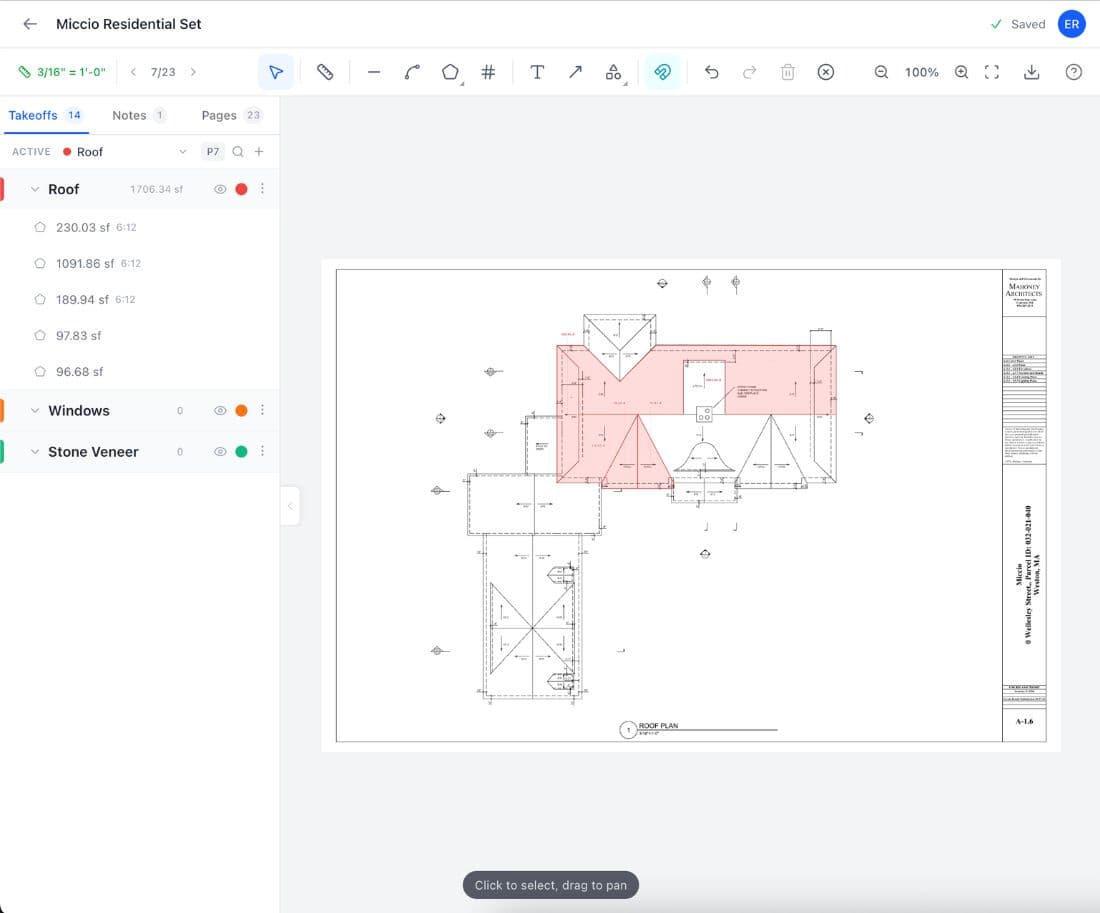
A general contractor takeoff is the process of measuring every trade scope across a plan set, from concrete and framing to MEP and finishes, so you can verify sub bids, price self-performed work, and catch scope gaps before they become change orders. You win one out of every five or six bids. The rest is unbillable time, and at $75 an hour internal rate, that is $300 to $450 per bid just for the takeoff on a kitchen remodel. Most GCs either trust the sub numbers and hope for the best, or roll a scale wheel across paper prints after the crew goes home. Construction takeoff software like PlanSwift costs $2,000 a year. Procore requires a custom annual quote based on selected products and annual construction volume. Easy Takeoffs is a browser-based tool for $39 a month that lets you measure any trade scope from a PDF plan set, verify sub quantities in minutes, and export grouped takeoffs straight into your estimating spreadsheet. Try every feature free for 14 days, no credit card required. Upload architectural, structural, mechanical, or site plans. Set the scale once per sheet and measure every scope: slabs and roofing, walls, footings, and pipe runs, doors, fixtures, and outlets. Group measurements by trade or bid package, each with its own color on the plan. Export to CSV and compare your numbers against every sub bid line by line. No software to install, no enterprise contract for your estimators, no learning curve. Easy Takeoffs also includes a General Contractor tool set with built-in material templates covering every major trade. Apply templates like Concrete Slab, Shingle Roof, Drywall Walls, or Tile Flooring to your measurement groups and get automatic material lists with waste factors, rounding, and formulas you can adjust to match each job.
Every Measurement Type
Areas, lines, counts, angles, and true curves, plus symbol search
Snap to Walls & Corners
Cursor locks to lines, corners, midpoints, and edges
Auto Scale Detection
Reads each sheet's scale; one tap confirms, one run sets every page
$39 a month
14-day free trial, no credit card, cancel any time
Any Device
Browser-based on Mac, Windows, tablet, or phone
What Is a General Contractors Takeoff?
A general contractor takeoff is the process of measuring quantities from construction drawings to verify subcontractor bids, catch scope gaps, and estimate self-performed work. Unlike a specialty sub who measures only their trade, a GC reviews every sheet in the plan set: A sheets for floor plans and elevations, S sheets for structural framing, C sheets for site work, and MEP sheets for mechanical, electrical, and plumbing scope. The goal is making sure that between your own crews and every subcontractor, 100 percent of the project is covered with zero gaps and zero overlaps. For self-performed work like demolition, framing, drywall, doors, trim, and painting, the GC runs a full detailed takeoff measuring areas, linear feet, and counts. For subcontracted work, the takeoff is a scope verification exercise: spot-check the sub quantities to make sure 500 square feet of tile is actually 500 square feet on the plans, not 350. One scope gap on a $300,000 remodel with a 9 percent margin can wipe out more than half of your expected profit.
How to Do a General Contractors Takeoff
Upload the full plan set
Drop your complete PDF plan set into Easy Takeoffs. Architectural, structural, civil, and MEP sheets all live in one project. Navigate between A sheets, S sheets, and site plans using the page selector.
Calibrate scale per sheet
Auto-detection reads the printed scale on each drawing and offers it for one-tap confirmation, and one run can set every page in the set at once. Calibrate from a known dimension when a sheet gives you nothing to read. A sheets at 1/4" = 1'-0", site plans at 1" = 20', and structural details at 3/4" = 1'-0" all coexist in the same project.
Measure every trade scope
Area tools for slabs, roofing, and flooring. Linear tools for wall framing, footings, and baseboard. Count tools for doors, windows, fixtures, and outlets, with symbol search that returns confirmed matches from one boxed example, checked by default for optional review or exclusion before bulk addition. Text search covers the whole set, so a keynote or door tag is a Ctrl+F away. Group measurements by trade, by floor, or by bid package with color-coded labels.
Export and compare to sub bids
Export grouped quantities to CSV. Compare your independent numbers against sub bids line by line. Catch scope gaps, missing items, and inflated quantities before you sign a subcontract. The annotated PDF export creates a visual record of what you measured.
Built for General Contractors
Multi-trade measurement
Measure any scope from a single tool. Area, linear, polyline, and count cover everything from concrete footings to electrical fixture counts to roofing squares.
Group by bid package
Organize measurements into color-coded groups by trade, floor, or building, with sub-groups nesting four levels deep so a floor can hold its units and each unit its trades. Export each group separately so your concrete quantities stay separate from your framing quantities.
CSV export for estimating
Export all quantities to CSV with group names, measurement types, and values. Opens directly in Excel, Google Sheets, or whatever estimating template you already use.
Auto scale detection
Most architectural PDFs have the scale printed on the sheet. Easy Takeoffs reads it automatically so you can start measuring immediately. When no scale is printed, calibrate manually from a known dimension.
Any device, any location
Runs in any browser on Windows, Mac, iPad, or Android. Pull up your takeoff at the jobsite, the plan room, or your truck. No software to install, no IT department needed.
$39 a month, flat
Easy Takeoffs is the cheapest dedicated takeoff tool built for general contractors. PlanSwift charges $2,000 a year per seat. Procore requires a custom quote based on selected products and annual construction volume. Bluebeam Revu Complete is $440. Easy Takeoffs is $39 a month or $399 a year, with a 14-day free trial and no credit card. Switching from PlanSwift saves $1,532 per estimator per year.
Built-in Material Templates for Every Trade
Apply built-in templates to your measurement groups for automatic material lists with waste factors and rounding. Templates cover every major trade from Concrete Slab and Shingle Roof to Drywall Walls, Tile Flooring, and Plumbing Fixture Rough-In. Adjust properties like slab thickness, stud spacing, or paint coverage to match your job.
Check your quantities before you bid
Each one shows the formula and a worked example so you can check the number, not just trust it. Free, no signup. For exact quantities, measure from your plans.
Square Footage Calculator
Area of any room or L-shape in square feet, yards, and meters, plus flooring and its cost.
Open calculator→
Framing Calculator
Studs, plates, headers, and board feet for a wall, with openings and 2026 lumber cost.
Open calculator→
Stair Calculator
Risers, treads, total run, stringer length, and angle for a stair, with live IRC code and comfort checks.
Open calculator→
General Contractors Waste Factors
Industry-standard waste percentages for common general contractors materials. Apply these to your measured quantities for accurate ordering.
Typical Waste Factors
Over-excavation, uneven subgrade, and form bulging add 3 to 7 percent above net calculated volume. Pump truck priming wastes another 0.25 to 0.5 cubic yards per pour.
Cutoffs from standard lengths, warped or split boards, and layout changes drive waste to 8 to 12 percent. Complex roof framing with hips and valleys pushes toward 15 percent.
4x8 sheets cut against irregular wall heights and gable ends waste 5 to 10 percent. Fewer cuts waste less; always order to the nearest full sheet.
Standard 4x8 or 4x12 sheets create unavoidable cutoffs at wall heights, window openings, and inside corners. Plan 10 to 15 percent waste for typical residential layouts.
Starter courses, hip and ridge caps, and valley cuts push waste to 12 to 17 percent for gable roofs and 15 to 20 percent for complex hip roofs.
Roller nap absorption, tray waste, touch-up reserves, and color changes between rooms account for 5 to 15 percent beyond calculated gallon coverage.
Miter cuts at corners, miscuts, and matching grain patterns on stain-grade trim waste 8 to 12 percent of total linear footage ordered.
Why General Contractors Contractors Need Better Takeoffs
Sub bids you cannot independently verify
A mechanical sub hands you a lump sum of $47,000. Is it competitive? You have no idea because you did not measure the duct runs, count the diffusers, or calculate the equipment connections. Without independent quantities, you are negotiating blind. A scope gap between the plumbing and HVAC subs cost one contractor $25,000 on a single airport project because nobody verified who was responsible for the underground electrical to the guard shack. A $39 a month digital takeoff tool lets you spot-check any scope in minutes, not hours.
Paying for software that sits idle most weeks
Most GCs do not measure plans every day. Bid season comes in waves. PlanSwift costs $2,000 a year, while Procore requires a custom annual quote tied to selected products and construction volume. Those commitments can be difficult to justify when takeoff software sits untouched for weeks at a time. Small to mid-size firms with fewer than 10 employees may default to paper prints and a scale wheel instead. Easy Takeoffs at $39 a month, with annual billing at $399, costs less than the competitors with public fixed prices and you can cancel any time the work slows.
Nights-and-weekends estimating
During the day, you are running active jobs. Estimating happens after hours because there is no one else to do it. A kitchen remodel takeoff takes 4 to 6 hours by hand. At a 1-in-6 win rate, most of that time produces zero revenue. Faster digital takeoffs mean you can bid more jobs in the same after-hours window, improving your bid-hit ratio without adding unbillable hours to your week.
One bad estimate erases a year of profit
Average GC net margins run 1.4 to 2.4 percent on commercial work and around 9 percent on residential. A 5 percent takeoff error on a $300,000 home is $15,000, more than half of your expected $27,000 profit. One contractor reported that a single scope gap "brought the company pretty much back to even" for the entire year. Accurate takeoffs are not a nice-to-have. They are the difference between making money and working for free.
Common General Contractors Takeoff Mistakes
Trusting sub quantities without verification
You receive five sub bids for concrete. Three are within 10 percent of each other, so you pick the lowest and move on. But nobody checked whether the lowest bidder excluded the loading dock apron that shows up on sheet C-3. The $8,000 gap lands on your desk as a change order after the contract is signed. Run your own takeoff on the critical scopes. You do not need to measure every bolt, but 15 minutes with the area tool on the site plan would have caught the missing apron before you committed to a number.
Missing scope between trades
The HVAC sub assumes the electrical sub handles equipment connections. The electrical sub assumes it is in the HVAC package. Neither bid includes the 200-amp disconnect, conduit run, and wiring. The $4,200 cost falls to you because the GC owns the gaps. On one airport project, an underground electrical run to a guard shack was excluded by every sub, costing the GC $25,000. Before finalizing, overlay every sub scope on the plans. Color-code each trade group in Easy Takeoffs and look for areas on the drawing that have no measurements from any sub. Those blank spots are your scope gaps.
Ignoring general conditions in the estimate
You total the sub bids, add your markup, and submit. But you forgot to price the dumpsters ($500 to $800 per pull), porta-johns ($175 per month), temp power ($1,200 setup), site fencing, and your superintendent time for the duration of the project. General conditions typically run 5 to 10 percent of project cost on commercial work. Build a general conditions checklist and price it as a line item, not a mental note. Missing $15,000 in general conditions on a $200,000 job cuts your margin from 10 percent to 2.5 percent.
Using one waste factor for all materials
Applying a flat 10 percent across the board sounds reasonable until you realize framing lumber wastes at 10 percent, but roofing on a complex hip roof wastes at 20 percent and concrete flatwork wastes at only 5 percent. A flat rate either over-orders cheap materials and under-orders expensive ones, or vice versa. Apply trade-specific waste factors from the table on this page. A few percentage points difference on a $150,000 material order is thousands of dollars in either direction.
Bidding without a second set of eyes
You finished the estimate at 11 PM, triple-checked the math, and submitted. The next morning you realize you used the wrong scale on the second-floor plan, which inflated every measurement by 20 percent. Your bid is now $40,000 too high on a $200,000 job. You will not win it, and you burned 8 hours of unbillable time. Digital takeoffs create an auditable record. When a second person reviews your project in Easy Takeoffs, they can see every measurement, every scale setting, and every group. Mistakes surface before the bid goes out, not after.
General Contractors Takeoff Pro Tips
Group measurements by CSI division
Create measurement groups that match the CSI MasterFormat divisions your estimating spreadsheet already uses: Division 3 Concrete, Division 6 Wood and Plastics, Division 7 Thermal and Moisture Protection, Division 9 Finishes. When you export to CSV, the data drops directly into the right rows without manual sorting. This also makes it easy to compare your quantities against sub bids organized by division. For residential work where CSI divisions feel like overkill, group by trade name instead: Concrete, Framing, Drywall, Paint, Flooring, Roofing. The point is consistency across projects so you build a library of unit costs over time. Color-code each group in Easy Takeoffs and you can visually scan the plan to confirm every area is covered by at least one measurement group. Blank spots on the drawing mean blank spots in the estimate.
Measure self-performed work first, then verify subs
Start your takeoff with the scopes your crews will handle: demolition, framing, drywall, doors, trim, painting, cleanup. These are the numbers you buy materials against, so they need full accuracy with proper waste factors. Spend the real time here. For subcontracted scopes, you do not need a line-by-line takeoff. Spot-check the big-ticket quantities. If the concrete sub says 142 cubic yards, spend 5 minutes tracing the footings and slab on the foundation plan to see if 142 is in the right ballpark. If your quick check says 160, call the sub and ask what they excluded. This two-tier approach, detailed for self-perform and verification for subs, lets a small GC produce a solid estimate in hours instead of days without skipping the diligence that prevents scope gaps.
Check the scale on every sheet independently
Architectural floor plans are usually 1/4" = 1'-0". But the site plan might be 1" = 20', structural details at 3/4" = 1'-0", and enlarged bathroom plans at 1/2" = 1'-0". If you set the scale on the first sheet and assume it carries through, every measurement on a differently scaled sheet will be wrong by the ratio of the scales. Easy Takeoffs auto-detects the scale from the printed notation when available, but always verify by measuring a known dimension like a door width (typically 3'-0" for interior, 3'-0" for exterior). If the tool reads 2'-8" when the door schedule says 3'-0", your scale is off. On large commercial plan sets with 50 or more sheets, architects occasionally print sheets at a different scale than what the title block says. Trust the measurement, not the label.
Build a bid-day template with reusable groups
Bid day for commercial work is chaotic. Sub numbers come in at the last minute, you are plugging and comparing while the clock ticks. If you have already measured the major scopes and organized them into named groups, you can swap sub numbers into your spreadsheet without remeasuring anything. Create a project template in Easy Takeoffs with your standard trade groups already set up: sitework, concrete, steel, framing, exterior, roofing, MEP, finishes. Upload plans, measure into those groups, and your CSV export is ready to receive sub pricing. On bid day, you are comparing numbers, not taking measurements. Save your completed takeoff projects as a reference library. When a similar project comes in, you can estimate from historical quantities and adjust for scale, which is faster than starting from scratch.
Always measure the site plan separately
GCs often focus on the building and overlook the site work: grading, paving, curbing, sidewalks, landscaping, utilities, storm drainage, and erosion control. On a commercial project, site work can be 15 to 25 percent of the total cost. Missing the parking lot repaving on a tenant improvement bid is a five-figure mistake. Open the civil sheets (C series) in Easy Takeoffs and measure site areas and linear runs as their own group. Paving area, curb linear footage, sidewalk area, utility trench lengths, and retention pond volume all need their own measurements. Compare these against the site sub bid the same way you verify building trades. For residential new construction, site work is simpler but still critical: driveway area, foundation excavation perimeter, backfill volume, and grading limits. A 20-foot driveway extension the homeowner requests mid-project is a $3,000 to $5,000 change order if you catch it, and a $3,000 to $5,000 loss if you do not.
General Contractors Takeoff Questions
Start Your Construction Takeoff Today
Upload your plans, measure your quantities, and export the results. Try the full software for 14 days, then choose $39 a month or $399 a year.