Roofing Takeoff Software
Measure roof areas from plan view drawings, apply slope factors for actual surface area, and calculate squares with built-in material templates for shingle and flat roofs. Group by roof zone and export material quantities. $39 a month or $399 a year, no credit card to start.
Roofing Takeoffs, Simplified
A roofing takeoff converts plan-view roof area into actual surface area using a slope factor, divides by 100 to give you squares (the unit shingles ship in), adds linear measurements for ridge cap, hip cap, valley metal, drip edge, and starter strip, and counts every penetration. A 30-square residential re-roof with architectural shingles runs $10,000 to $15,000 in material alone. Overestimate by three squares and you have $300 to $450 in shingles sitting in the driveway that you cannot return once the wrapper is opened. Underestimate by three squares and your crew stands idle while you chase a mid-job delivery from the supply house, burning $720 in labor waiting. Either way, the takeoff is where the bid gets won or lost. Most roofing contractors still eyeball roof areas from a ladder or guess from satellite images, then pad the number and hope the waste factor covers any errors. Easy Takeoffs is roofing bid software for $39 a month that measures roof areas directly from PDF plan sets. Trace each roof plane with the polygon tool to get plan-view area, then multiply by the slope factor for your pitch to convert to actual surface area. Measure ridge lines, hip lengths, valley runs, eaves, and rakes with the linear tool for accessory quantities. Count penetrations like pipe boots, skylights, and chimney flashings. Group measurements by roof zone so shingle areas, flat sections, and metal panels each get their own material list. Export to CSV and hand the quantities straight to your supplier. Try every feature free for 14 days, no credit card. Built-in roofing templates for Shingle Roof and Flat Roof Membrane generate full material lists from your measured areas. The Shingle Roof template calculates bundles, underlayment, ice and water shield, starter strip, ridge cap, and drip edge. The Flat Roof Membrane template handles TPO, EPDM, or PVC with seam adhesive, fasteners, and optional insulation board. Adjust properties like ice shield inclusion or membrane attachment method to match your spec.
Every Measurement Type
Areas, lines, counts, angles, and true curves, plus symbol search
Snap to Walls & Corners
Cursor locks to lines, corners, midpoints, and edges
Auto Scale Detection
Reads each sheet's scale; one tap confirms, one run sets every page
$39 a month
14-day free trial, no credit card, cancel any time
Any Device
Browser-based on Mac, Windows, tablet, or phone
What Is a Roofing Takeoff?
A roofing takeoff is the process of measuring roof areas, linear dimensions, and penetration counts from construction drawings to calculate every material needed for a roofing project. The foundation is converting plan-view area, which is the horizontal footprint visible from above, into actual roof surface area by multiplying by the slope factor for the given pitch. A 6/12 pitch has a slope factor of 1.118, meaning every 1,000 square feet of plan-view area is actually 1,118 square feet of roof surface. That surface area divided by 100 gives you roofing squares, which is how shingles are ordered. Squares are only part of the order. A complete roofing takeoff also includes linear footage for ridge cap, hip cap, valley metal, drip edge, rake trim, and starter strip along eaves. Each penetration needs its own flashing: plumbing vents get pipe boots, furnace exhausts get split boots rated for high temperature, skylights need full flashing kits at $50 to $150 each, and chimneys require step flashing plus a cricket. Underlayment is calculated from gross roof area with overlap allowance. In cold climates, ice and water shield covers the first three feet from every eave, every valley, and around every penetration. Most roofing estimating software bundles pricing databases you may not need; the core takeoff step is about accurate measurement, which is what Easy Takeoffs covers for $39 a month.
How to Do a Roofing Takeoff
Upload roof plans
Drop your architectural PDF roof plans into Easy Takeoffs. Plan-view roof drawings show the footprint from above with ridge lines, valleys, hips, and eave lines marked. Multi-page support handles projects with separate roof plan sheets, enlarged details, and elevation views all in one project.
Calibrate scale and measure areas
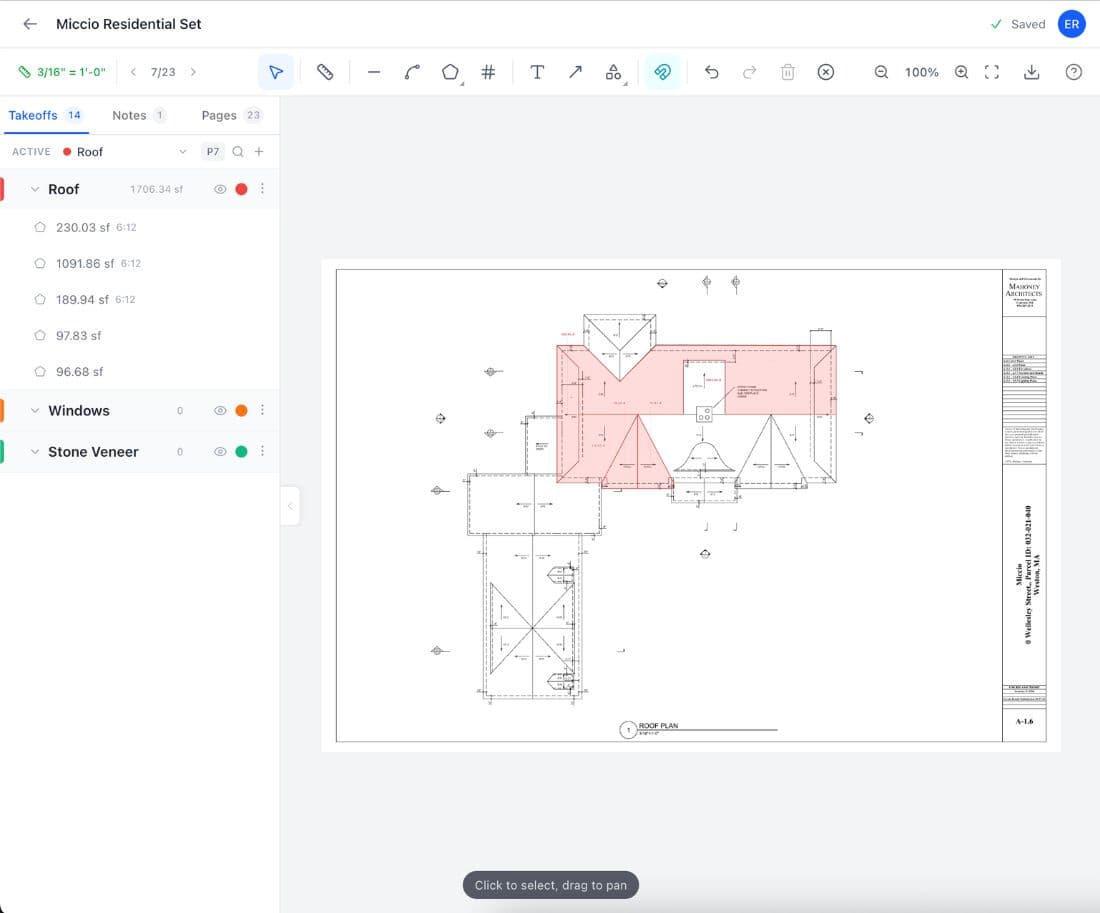
Set the drawing scale using a known dimension or let auto-detection read it from the printed scale on the drawing. Trace each roof plane with the polygon tool to get plan-view area. Complex roofs with dormers, hips, and multiple pitches get separate polygons for each plane, grouped by roof zone.
Measure linear runs and count penetrations
Switch to the linear tool and trace ridge lines, hip lines, valley runs, eave edges, and rake edges. These drive accessory quantities: ridge cap, valley metal, drip edge, and starter strip. Use the count tool for every penetration: pipe boots, skylights, chimneys, and exhaust vents.
Apply slope factor and export
Set the pitch on each roof zone and the software applies the slope factor for you: a 4/12 uses 1.054, a 6/12 uses 1.118, an 8/12 uses 1.202, and any custom pitch can be typed. Plan-view areas become true surface areas automatically. Export grouped quantities to CSV with shingle squares, linear accessory footage, and penetration counts organized for your supplier order.
Built for Roofing
Roof plane area measurement
Trace each roof plane with the polygon tool to get plan-view area. Complex hip roofs, cross-gable intersections, and dormer cheek walls each get their own polygon. The tool handles any shape so irregular roof plans with bump-outs and setbacks measure accurately.
Ridge, hip, valley, and eave lengths
Linear measurements drive accessory material orders. Ridge cap runs the full ridge length. Valley metal comes in 10-foot pieces. Drip edge covers every eave and rake. Starter strip runs the full eave perimeter. Measure each run with the linear tool and group by accessory type.
Penetration counting by type
Every roof penetration needs its own flashing. Plumbing vents get pipe boots, furnace exhausts need split boots rated for high temperature, skylights require full flashing kits at $50 to $150 each, and chimneys need step flashing plus a cricket. Count each type separately, or box one vent symbol and let symbol search return confirmed matches across the set. Review the checked results against the plan before finalizing the quantity.
Zone grouping by roof section
A single project might have architectural shingles on the main roof, three-tab on the back slope, flat TPO on the garage, and standing seam on the entry portico. Group each zone with its own color so the material list separates naturally by product type.
Auto scale detection
Most architectural PDFs have the scale printed on the sheet, which Easy Takeoffs reads automatically. When no scale is printed, click two points on any dimensioned line and enter the known distance. Each page can have its own scale for enlarged roof details.
$39 a month, flat
Easy Takeoffs is the cheapest dedicated roofing takeoff tool on the market. PlanSwift charges $2,000 a year. STACK runs $2,988 or more. EagleView charges per report. Bluebeam Revu Complete is $440. Easy Takeoffs is $39 a month or $399 a year, with a 14-day free trial and no credit card. Switching from PlanSwift saves $1,532 per estimator per year.
Built-in Roofing Templates
Apply the Shingle Roof or Flat Roof Membrane template to your measurement groups for automatic material lists with waste factors and rounding. The shingle template calculates bundles, underlayment, ice and water shield, starter strip, ridge cap, and drip edge. The flat roof template covers membrane, seam adhesive, and fasteners. Adjust properties like ice shield inclusion or attachment method to match your spec.
Check your quantities before you bid
Each one shows the formula and a worked example so you can check the number, not just trust it. Free, no signup. For exact quantities, measure from your plans.
Roofing Waste Factors
Industry-standard waste percentages for common roofing materials. Apply these to your measured quantities for accurate ordering.
Typical Waste Factors
Simple gable roofs with straight runs and minimal hips have the lowest cut waste. Most loss comes from starter course cutbacks, ridge cap trimming, and partial bundles at the end of each roof plane. Three bundles per square is the standard, but the last bundle on each plane rarely comes out even.
Every hip and valley creates angled cuts along its full length. A single valley wastes 15 to 20 shingles in cuts. Multiple dormers, cross gables, and intersecting roof planes compound the waste. On a complex 40-square residential roof, 18 percent waste adds about 7 extra squares to the order.
Factory-cut panels ordered to exact length minimize field waste. Waste comes from hip and valley angle cuts, penetration openings, and panel end trimming. Custom-length ordering on simple roofs reduces waste to 5 percent. Stock-length panels on complex roofs push waste to 12 percent.
Membrane rolls come in standard widths of 6, 8, 10, or 12 feet. Waste comes from the 6-inch heat-welded seam overlap at every roll edge, termination bar details at parapets, and cuts around rooftop units, drains, and pipes. Narrow roof sections that do not match the roll width generate the most waste.
Horizontal overlaps of 4 inches and vertical end-lap overlaps of 6 inches consume roughly 10 percent of each roll. Additional waste comes from cuts at valleys, hips, and eave edges. Torn sections during high-wind installation on steep slopes add another 2 to 3 percent.
Self-adhering membrane is positioned precisely at eaves, valleys, and around penetrations, so overlap waste is minimal. Most waste comes from trimming at irregular roof edges and discarding damaged sections where the release liner tears prematurely. Each 200 square foot roll covers about 2 squares of eave protection.
Metal drip edge comes in 10-foot pieces with 2-inch overlap joints. Waste depends on how eave and rake lengths divide into those increments. A 23-foot rake needs 3 pieces with 7 feet of usable scrap. Step flashing cut from flat stock at chimneys and sidewalls wastes 10 to 15 percent of the sheet.
Why Roofing Contractors Need Better Takeoffs
Forgetting the slope factor on a steep pitch
A crew measures a roof footprint at 2,800 square feet from the plan view and orders 28 squares of GAF Timberline HDZ at $130 per square. But the roof is an 8/12 pitch with a slope factor of 1.202. The actual surface area is 3,366 square feet, which is 34 squares. Six squares short is $780 in material you did not order, plus a half-day delay while the supply house pulls and delivers the shortage. Your crew of four at $45 per hour burns $720 in idle labor. A $1,500 mistake from one missed multiplication.
Ordering shingles without counting linear accessories
Shingle squares get all the attention, but a typical 30-square residential re-roof has 80 to 120 linear feet of ridge and hip cap, 60 to 100 feet of valley metal, 200 feet of drip edge, and 200 feet of starter strip. Skip the linear measurements and your material order is missing $400 to $800 in accessories. The crew finishes the field shingles, gets to the ridge, and there is no cap. You send someone to the supply house for a second trip, losing an hour of production from the whole crew waiting.
Bidding from a drive-by instead of the plans
A contractor drives past a house, eyeballs the roof at "about 25 squares," and submits a bid. The actual measured area is 31 squares after slope factor. On a bid with 12 percent margin, being off by 6 squares at $130 per square in material plus $250 per square in labor means the $2,280 error eats the entire profit and then some. The job that was supposed to make $4,500 now loses money. Measuring from the actual plans in Easy Takeoffs takes 15 minutes and eliminates the guesswork.
Common Roofing Takeoff Mistakes
Measuring plan-view area without slope correction
Plan-view drawings show the horizontal projection of the roof, not the actual surface you are shingling. A 1,000 square foot footprint on a 6/12 pitch is actually 1,118 square feet of roof surface. On a 10/12 pitch, it is 1,302 square feet. Skipping the slope factor underestimates every material quantity on the job, from shingles to underlayment to ice shield. Multiply plan-view area by the slope factor before calculating anything else. The five most common residential factors: 4/12 is 1.054, 6/12 is 1.118, 8/12 is 1.202, 10/12 is 1.302, and 12/12 is 1.414.
Using one waste factor for every roof shape
A simple gable roof wastes 10 percent. A complex hip roof with dormers and valleys wastes 18 to 20 percent. Applying a flat 12 percent to everything means over-ordering on simple jobs and running short on complex ones. A complex 35-square roof at 12 percent waste instead of 18 percent is 2 squares short, which is $260 in emergency material plus the supply house delivery wait. Assess the roof geometry before choosing a waste factor. Count the hips, valleys, and dormers. Each intersection adds angled cuts that generate unusable offcuts. More intersections mean a higher factor.
Ignoring underlayment and ice shield quantities
Contractors focus on shingle squares and forget that underlayment covers the entire roof deck with overlap, not just the net area. On a 30-square roof, synthetic underlayment with horizontal and end-lap overlaps needs about 34 squares of coverage. Ice and water shield in a cold climate can add 5 to 8 rolls at $50 to $230 each depending on brand. Calculate underlayment from the gross roof area plus 10 to 15 percent for overlaps. Calculate ice shield separately based on linear eave footage times 36 to 48 inches of coverage, valley lengths, and a piece around every penetration.
Lumping starter strip into the shingle square count
Starter strip runs the full eave and rake perimeter. On a 30-square house with 200 linear feet of combined eave and rake, you need 7 to 8 bundles of dedicated starter product at roughly 100 to 120 linear feet per bundle. Contractors who fold starter into their shingle square count end up short on field shingles because the starter consumed bundles from the order. Order starter strip as a separate line item. Measure the full eave and rake perimeter with the linear tool and calculate starter bundles from the manufacturer coverage, typically 100 to 120 linear feet per bundle for GAF or CertainTeed starter.
Counting pipe boots but missing specialty flashings
Standard plumbing vent pipe boots are easy to spot and count. But furnace exhaust vents need split boots rated for high temperature. B-vent chimneys need storm collars and roof jacks. Skylights require full-frame flashing kits at $50 to $150 each. Missing two skylight kits is $100 to $300 not in the bid, plus a second order that delays the crew. Count every penetration by type, not just total quantity. Pipe boots, split boots, skylight kits, chimney step flashing, and exhaust vent collars are each separate line items with different costs and lead times.
Roofing Takeoff Pro Tips
Build a slope factor reference into your workflow
Memorize or tape a card to your monitor with the five most common slope factors: 4/12 is 1.054, 5/12 is 1.083, 6/12 is 1.118, 8/12 is 1.202, 10/12 is 1.302. These cover 90 percent of residential roofs. For unusual pitches, the formula is the square root of (1 plus (rise divided by run) squared). Apply the slope factor immediately after measuring each roof plane, not at the end. If you measure six separate planes and apply the factor to each one individually, you catch pitch variations across the roof. Many houses have a 6/12 main roof with a 4/12 porch roof and a 3/12 over the garage. Treating them all as 6/12 throws off every quantity. When the plans do not show pitch, check the building elevations. Measure the vertical rise and horizontal run from the elevation drawing to calculate pitch directly. If elevations are not in the set, a site visit with an angle finder or pitch gauge gives you the number in seconds.
Measure linear accessories as you trace each plane
After tracing a roof plane for area, immediately switch to the linear tool and measure the ridge, hip, eave, and rake edges of that same plane. Assign each measurement to an accessory group: ridge cap, valley metal, drip edge, starter strip. If you wait until after measuring all areas to go back for linear runs, you scroll through the plan a second time trying to remember which edges you already captured. On a complex roof with 15 or 20 planes, this wastes 30 minutes and risks missing edges buried under overlapping polygons. Linear accessories are a bigger share of the material order than most contractors expect. On a typical 30-square residential re-roof, ridge cap, valley metal, drip edge, and starter strip combined add $600 to $1,200 to the material cost. Missing half of those quantities means a second supply run and a crew standing on the roof waiting.
Group measurements by roof zone for staging
Create separate measurement groups for each distinct roof zone: main house, garage, porch, addition, dormers. Within each zone, capture areas, linear runs, and penetration counts. This structure gives you a zone-by-zone material breakdown that matches how crews actually stage and work a roof. A crew does not shingle the entire roof at once. They work zone by zone, starting where the conveyor drops material. If your takeoff shows the main house at 22 squares and the garage at 8 squares, you can pre-stage material at each zone before the crew starts. Without zone grouping, you have one lump total and no way to plan staging or track progress. Zone grouping also catches scope gaps. If you count five zones on the roof plan but only four in your takeoff, you know immediately that a section was missed. A single total of 30 squares hides the gap until the crew reaches the unmeasured area and you are short material.
Verify scale against a known roof dimension
Roof plans are sometimes printed at a different scale than labeled, especially when architects email reduced-size PDFs or when a GC prints full arch sheets on letter paper. A plan labeled 1/4 inch equals 1 foot that was printed at 85 percent is off by 15 percent on every measurement. Before starting the takeoff, find a dimensioned line on the plan. Roof plans often show overall building dimensions, ridge-to-eave distances, or overhang depths. Calibrate the scale against that known dimension in Easy Takeoffs. If the calibrated scale does not match the printed label, trust the calibration. A 15 percent scale error on a 30-square roof means your takeoff reads 25.5 squares. You order 26 squares and show up 4 squares short on install day. At $130 per square for architectural shingles, that is $520 in emergency material plus the delivery fee and crew downtime.
Apply waste to shingles but not to linear accessories
Shingle waste factors account for cuts at hips, valleys, and roof edges. But drip edge, valley metal, and ridge cap are ordered by the piece in 10-foot lengths. Adding a percentage waste factor to linear accessories double-counts the margin because you are already rounding up to the nearest full piece. For a 73-foot eave, you need 8 pieces of 10-foot drip edge, giving you 80 feet with 7 feet of usable scrap. Adding 10 percent waste and ordering 9 pieces is unnecessary. The rounding already covers it. The exception is step flashing at chimneys and sidewalls. Step flashing pieces are cut from flat stock in 5x7 or 8x8 inch sizes, and each chimney junction generates cutoff waste that cannot be reused. Order 10 to 15 percent extra on flat flashing stock for those custom cuts.
Roofing Takeoff Questions
Start Your Construction Takeoff Today
Upload your plans, measure your quantities, and export the results. Try the full software for 14 days, then choose $39 a month or $399 a year.