Painting Takeoff Software
Measure wall areas, ceiling zones, trim linear footage, and exterior facade square footage from PDF floor plans and elevations. Apply built-in paint templates for automatic gallon calculations. Group by scope and product. $39 a month. Two weeks of full access before anything bills.
Painting Takeoffs, Simplified
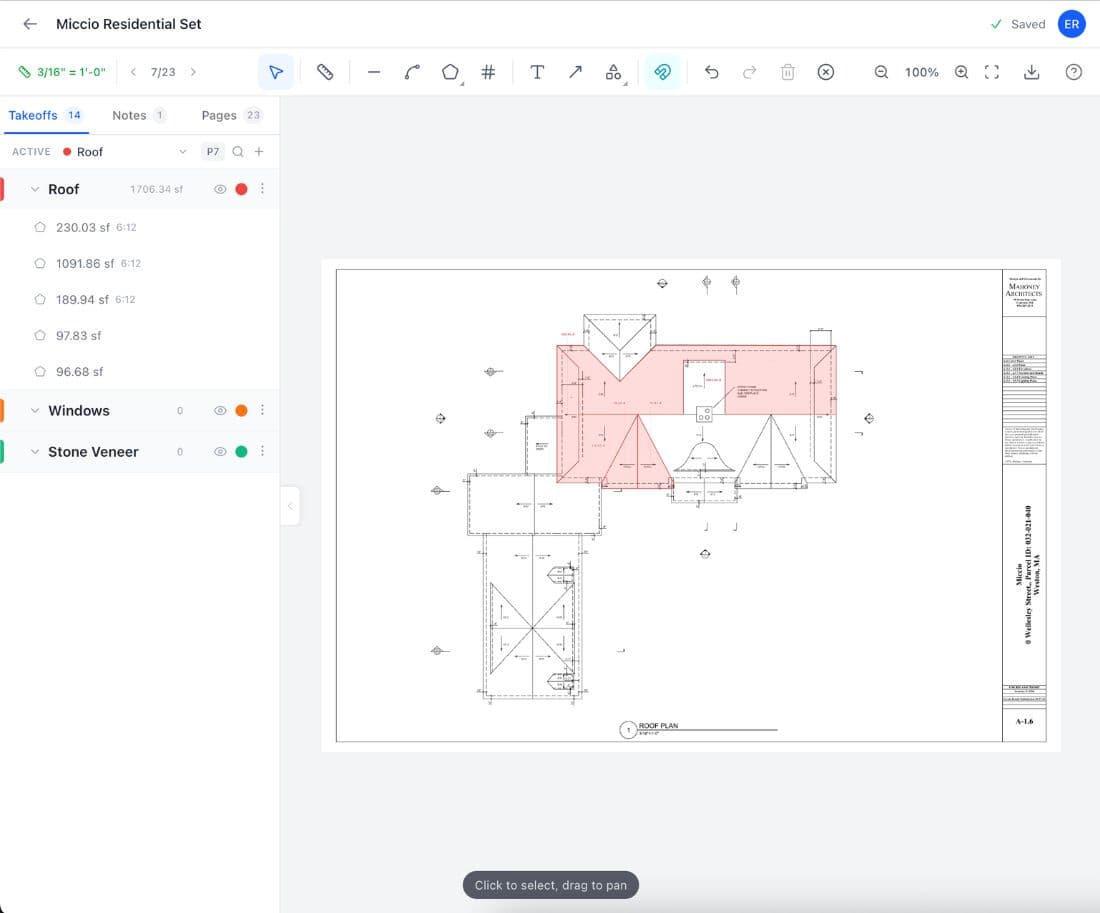
A painting takeoff is wall area, ceiling area, trim linear footage, and exterior facade square footage, grouped by product and sheen so the right paint goes on the right surface. Divide area by coverage rate, multiply by coats, and you have gallons to order. A painting crew that runs out of Sherwin-Williams Emerald mid-job cannot just grab a bucket of Duration from the truck. The sheen does not match, the coverage is different, and the homeowner will see the line where the switch happened. So you send a painter to the store, and the rest of the crew sits idle at $35 to $50 per hour per painter while they wait. On a four-painter crew, one hour of downtime is $140 to $200 in burned labor. On a commercial repaint with 40,000 square feet of wall area, being off by 10 percent means you are short 12 gallons at $60 to $85 per gallon for premium interior paint. That is $720 to $1,020 in material plus the labor delay. Easy Takeoffs gives painting contractors a browser-based tool for $39 a month to measure wall areas, ceiling zones, and trim runs from PDF floor plans and elevations. Try every feature free for 14 days, no credit card. Trace room perimeters with the polyline tool to get total linear wall footage, then multiply by ceiling height for paintable wall area. Subtract door and window openings using the count tool. Use the polygon tool on elevation drawings for exterior facade areas. Group measurements by scope: interior walls, ceilings, trim, doors, exterior siding, and accent walls. Each group represents a different product, sheen, or color. Export to CSV for your paint estimating software or spreadsheet, then calculate gallons by dividing area by coverage rate, multiplied by the number of coats. Built-in templates for Interior Paint and Exterior Paint let you apply a template to any measurement group and get gallon counts, primer quantities, and accessory totals automatically. The Interior Paint template calculates finish gallons based on your coverage rate and number of coats, plus primer if needed. The Exterior Paint template adjusts for surface type (smooth siding, stucco, or brick) and includes caulk tubes. Adjust every property to match the actual product and conditions on your job.
Every Measurement Type
Areas, lines, counts, angles, and true curves, plus symbol search
Snap to Walls & Corners
Cursor locks to lines, corners, midpoints, and edges
Auto Scale Detection
Reads each sheet's scale; one tap confirms, one run sets every page
$39 a month
14-day free trial, no credit card, cancel any time
Any Device
Browser-based on Mac, Windows, tablet, or phone
What Is a Painting Takeoff?
A painting takeoff is the process of measuring all paintable surfaces from construction drawings to calculate the square footage, linear footage, and gallon quantities needed for a painting project. The core measurement is wall area, calculated by multiplying each room's wall perimeter by the ceiling height, then subtracting door and window openings. A standard interior door opening deducts 21 square feet (3 feet by 7 feet) and a standard window deducts about 15 square feet. Ceilings are measured as floor area from the reflected ceiling plan or floor plan. Trim is measured in linear feet: baseboard, crown molding, chair rail, door and window casings, and wainscoting cap. The takeoff then converts surface area into material quantities. Interior latex paint on smooth drywall covers 350 to 400 square feet per gallon per coat. Textured surfaces drop coverage to 250 to 300 square feet per gallon. Primer on new drywall covers 300 to 350 square feet per gallon because bare drywall and joint compound absorb heavily. Each product and each surface condition gets its own coverage rate. Multiplying total area by the number of coats and dividing by coverage per gallon gives you the gallons to order. A 3,000 square foot interior repaint at 2 coats with 375 square feet per gallon coverage needs about 16 gallons of finish paint plus 9 gallons of primer for any new drywall patches.
How to Do a Painting Takeoff
Upload floor plans and elevations
Drop your PDF plans into Easy Takeoffs. Floor plans give you wall perimeters and ceiling areas for interior scope. Elevation drawings give you exterior facade areas directly. Multi-page support handles full plan sets with architectural floor plans, reflected ceiling plans, and all four building elevations in one project.
Trace wall perimeters and ceiling zones
Use the polyline tool to trace each room's wall perimeter on the floor plan. The total length multiplied by ceiling height gives paintable wall area. For ceilings, trace the room outline with the polygon tool for the ceiling area. On elevation drawings, trace exterior facade sections directly for exterior wall area.
Group by scope, product, and sheen
Create measurement groups for each painting scope: interior walls in eggshell, ceilings in flat, kitchen and bath in semi-gloss, trim in semi-gloss, exterior body in satin, and exterior trim in gloss. Each group gets a distinct color on the plan so you can see coverage at a glance and spot missed rooms.
Count openings, export, and calculate gallons
Mark doors and windows for opening deductions with the count tool, or box one door symbol and inspect the confirmed matches before bulk addition. Standard deductions are 21 square feet per door and 15 square feet per window. Export grouped measurements to CSV with wall areas, ceiling areas, and trim linear footage by scope, and let the paint templates turn areas into gallons with coats and waste applied.
Built for Painting
Wall perimeter to area calculation
Trace room wall runs with the polyline tool to get total linear perimeter, then set the wall height on the group and the software computes paintable wall area for you. A 14-by-18-foot room has 64 linear feet of perimeter; at 9-foot ceilings, that is 576 square feet of wall area before opening deductions, calculated the moment the run is drawn.
Ceiling and exterior facade areas
Use the polygon tool to trace ceiling zones on floor plans and exterior facade sections on elevation drawings. Vaulted ceilings, coffered ceilings, and irregular facade shapes all measure accurately with the polygon tool. Each zone gets its own area in the export.
Scope and product grouping
Create a group for each paint product and sheen: Sherwin-Williams Emerald in eggshell for living areas, ProMar 200 in flat for ceilings, Duration in satin for exteriors. Each group tracks its own square footage total so you can calculate gallons per product directly from the export.
Door and window counting for deductions
Mark every door and window with the count tool. Standard interior doors deduct 21 square feet each. Standard windows deduct 15 square feet. Sliding glass doors deduct 40 square feet. On a 15-room house, accurate opening counts can reduce total wall area by 500 to 800 square feet.
Room labels for spec matching
Label each measurement with the room name or finish schedule room number. On commercial projects, labels map your takeoff directly to the Division 9 paint schedule. On residential work, labels let you create room-by-room estimates that homeowners can read and understand.
$39 a month, flat
Easy Takeoffs is the cheapest dedicated painting takeoff tool on the market. PlanSwift charges $2,000 a year per seat. STACK starts at $2,988. Bluebeam Revu Complete is $440. PaintScout and other painting-specific platforms charge monthly. Easy Takeoffs is $39 a month or $399 a year, with a 14-day free trial and no credit card. Switching from PlanSwift saves $1,532 per estimator per year on monthly billing.
Built-in Paint Templates
Apply Interior Paint or Exterior Paint templates to your measurement groups for automatic gallon calculations with waste factors and rounding. Adjust properties like number of coats, coverage rate, whether primer is needed, and surface type to match your job. The templates calculate finish paint gallons, primer gallons, and caulk tubes from your measured area.
Painting Waste Factors
Industry-standard waste percentages for common painting materials. Apply these to your measured quantities for accurate ordering.
Typical Waste Factors
Rolling on smooth, primed drywall wastes 8 to 12 percent. Roller nap absorption holds about 2 ounces of paint that never transfers to the wall. Tray and bucket transfer waste adds another 1 to 2 percent. Two coats at 375 square feet per gallon is the safe planning number.
Orange peel, knockdown, and heavy texture increase surface area by 15 to 40 percent compared to smooth drywall. Coverage drops from 375 to 250 to 300 square feet per gallon. The texture valleys trap paint, and the peaks need extra material for uniform hide.
Airless spraying wastes 20 to 30 percent from overspray, bounce-back off corners and trim edges, and atomization loss. Most commercial interior spraying uses a back-roll technique that adds a second pass but reduces lap marks. Factor 20 percent minimum even in controlled indoor conditions.
Exterior spraying on siding, stucco, or brick adds wind drift, overspray past building edges, and masking waste. Coverage on rough substrates like stucco drops to 200 to 250 square feet per gallon. Budget 25 percent waste for exterior spray applications.
Bare drywall and joint compound absorb primer heavily on the first coat. Coverage drops to 300 to 350 square feet per gallon compared to the 400 square foot label rate. Butt joints and corner bead compound absorb even more. Budget 15 percent extra over the labeled rate.
Wood grain absorption varies dramatically by species. Pine and poplar absorb stain quickly and unevenly. Oak and walnut are more predictable. End grain on stair treads absorbs 3 to 5 times the face grain rate. Coverage ranges from 200 to 350 square feet per gallon depending on the wood.
A standard 10.1-ounce tube covers roughly 50 to 60 linear feet of a 1/4-inch bead. Waste comes from partially used tubes that dry out between rooms, dispensing waste at the start and end of each tube, and tooling excess. Budget one tube per 45 to 50 linear feet.
Why Painting Contractors Need Better Takeoffs
Running short of color-matched paint mid-project
You ordered 14 gallons of Benjamin Moore Regal Select in HC-172 Revere Pewter for a whole-house repaint. The crew gets to the last bedroom and the bucket is empty. The store has HC-172 in stock but only in Aura, not Regal Select. Different product lines have different sheens even at the same finish level. Now you are waiting for a special mix while three painters sit idle at $40 per hour each. Two hours of downtime is $240 in burned labor over a $50 gallon of paint you under-ordered.
Measuring 30 rooms by hand from a scale ruler
A commercial repaint with 30 rooms means calculating wall perimeter times ceiling height minus openings for every single room. That is 30 perimeter measurements, 30 ceiling height lookups, 30 opening deduction counts, and 30 area calculations done by hand with a scale ruler and a calculator. Miss one room and your bid is short by 400 to 800 square feet. A polyline tool in Easy Takeoffs traces the perimeter in seconds and gives you the linear footage. Multiply by ceiling height once per floor, subtract standardized opening deductions, and the wall area is done.
Mixing interior and exterior scopes in one lump estimate
A painting bid covers interior walls in eggshell, ceilings in flat, trim in semi-gloss, exterior body in satin, and exterior trim in gloss. That is five different products, five different coverage rates, and five different labor production rates. Lumping everything into one square footage total means you cannot calculate accurate gallons for any product. The estimator who separates scope into measurement groups can calculate gallons per product, price each product at its actual cost, and apply the correct labor rate per scope. The result is a tighter bid with better margins.
Common Painting Takeoff Mistakes
Forgetting to deduct door and window openings
A typical 3-bedroom house has 15 to 18 interior doors and 12 to 15 windows. At 21 square feet per door and 15 square feet per window, that is 495 to 603 square feet of openings. Skipping the deduction means over-ordering 1 to 2 gallons of paint, which is $50 to $170 in wasted material. More importantly, it inflates your bid by that amount and may cost you the job. Use the count tool to mark every door and window on the floor plan. Apply standard deductions: 21 square feet for interior doors, 15 square feet for standard windows, 40 square feet for sliding glass doors. Subtract the total from gross wall area.
Using one coverage rate for every surface
Smooth drywall at 375 square feet per gallon is not the same as knockdown texture at 275 square feet per gallon, which is not the same as exterior stucco at 225 square feet per gallon. Using 350 for everything means you over-order for smooth surfaces and run short on textured ones. On a 5,000 square foot exterior stucco job, using 350 instead of 225 means you calculate 29 gallons when you actually need 45. Match the coverage rate to the actual surface condition. Check the product TDS (technical data sheet) for the manufacturer's recommended spread rate, then adjust downward for rough or porous surfaces.
Bidding walls without measuring trim separately
A 2,500 square foot house has 600 to 900 linear feet of baseboard, 200 to 300 linear feet of door and window casing, and potentially crown molding. Trim is painted with a different product (usually semi-gloss or high-gloss), applied by brush, and takes 2 to 3 times longer per square foot than rolling walls. Folding trim into the wall area means your labor estimate is wrong. Measure trim linear footage separately with the polyline tool. Budget 100 to 150 linear feet per gallon for trim (factoring narrow coverage width and brush application). Price trim labor at $1.50 to $3.00 per linear foot, separate from wall labor.
Assuming two coats when some areas need three
Two coats is the standard, but color changes from dark to light can need three coats even with tinted primer. Going from a deep red accent wall to a light gray requires a gray-tinted primer plus two finish coats minimum. Skipping the third coat leaves bleed-through that the homeowner will notice in afternoon sunlight. Check existing wall colors during the walkthrough. Any dark-to-light color change should be bid at three coats. Flag accent walls, children's rooms with bold colors, and any surface with water stains or nicotine that will bleed through without extra coats.
Not accounting for ceiling height variations
Standard 8-foot ceilings are easy. But many newer homes have 9 or 10-foot ceilings on the main floor, vaulted ceilings in the great room, and 8-foot ceilings upstairs. A 14-by-18 room with 10-foot ceilings has 640 square feet of wall area. The same room at 8-foot ceilings has 512 square feet. Bidding everything at 8 feet underestimates by 25 percent on 10-foot rooms. Note ceiling heights per floor or per room during the takeoff. Most floor plans note ceiling heights in the room labels or on the architectural sections. Apply the correct height to each room's perimeter measurement.
Painting Takeoff Pro Tips
Create groups that match your paint order
Set up measurement groups by product and sheen, not just by room. One group for "SW Emerald Eggshell - Living Areas," another for "SW ProMar 200 Flat - Ceilings," another for "SW Duration Semi-Gloss - Trim." When you export, each group total divides directly by the product coverage rate to give you gallons. This eliminates the step where you take your total area, manually sort by product, and recalculate. It also catches ordering mistakes: if your "Ceilings" group shows 2,400 square feet but the floor plan shows 3,000 square feet of floor area, you know you missed some rooms. For multi-color residential work, create a group per color. "HC-172 Revere Pewter - Main Level Walls" and "OC-17 White Dove - Upstairs Walls" each track their own square footage. Your paint order maps one-to-one with your measurement groups.
Measure the perimeter once and multiply by two heights
On open floor plans where the main level has 10-foot ceilings and the upper level has 8-foot ceilings, trace the exterior wall perimeter once on the main level floor plan. Export that perimeter length. Multiply by 10 for the main level wall area and by 8 for the upper level. This shortcut works because the exterior wall perimeter is the same on both floors in a standard two-story house. Interior partition layouts differ between floors, but the exterior shell is consistent. For interior walls, you still need to trace each floor separately because room layouts change. The same technique applies to commercial tenant spaces with consistent ceiling heights per floor. Measure the perimeter once per floor, multiply by the tenant height, and subtract openings. A 15-floor office building with identical floor plates means you measure one floor and multiply the area by 15.
Use the finish schedule on commercial projects
Commercial painting specs live in Division 9 of the project manual. The finish schedule assigns specific paint products, sheens, and color numbers to every room by room number. Open the finish schedule alongside the floor plans in Easy Takeoffs and cross-reference as you measure. Create your measurement groups to match the spec designations. If the spec calls for "Paint Type P1: Sherwin-Williams Duration, Eggshell, 2 coats" and "Paint Type P2: ProMar 400, Flat, 2 coats on ceilings," name your groups P1 and P2. Your exported quantities map directly to the bid form without translation. Catching a product assignment error during the takeoff costs zero. Catching it when the crew sprays the wrong product on 4,000 square feet of corridor walls costs a full day of labor to reprime and recoat, plus the wasted material.
Factor in primer separately for new construction
On new construction, every surface needs primer plus finish coats. Primer coverage on bare drywall is 300 to 350 square feet per gallon, not the 400 the label claims, because joint compound and paper face absorb at different rates. Budget primer as a separate line item with its own coverage rate and gallon count. On repaints, primer is only needed on patches, stain blocking, and color changes. Estimate primer for 10 to 20 percent of the total wall area on a typical repaint, focused on patched areas and ceilings with water stains. Primer is often a different price point than finish paint. Sherwin-Williams PVA primer runs $15 to $20 per gallon. Their premium Multi-Purpose primer runs $30 to $40. Finish coats of Emerald run $75 to $85. Separating primer from finish in your takeoff prevents the common mistake of pricing everything at the finish coat rate.
Add 5 to 10 percent for touch-up and punch list
Every painting job ends with a punch list walkthrough. The GC marks scuffs from drywall hangers, dings from trim carpenters, and spots where other trades leaned ladders against freshly painted walls. On new construction, punch list touch-up can consume 5 to 10 percent of the total paint ordered. Build touch-up material into the original order. You need the exact same batch and color for touch-ups to blend. Paint mixed weeks later from the same formula may not match due to tint base variation between batches. Leave a labeled quart of each color on site for the homeowner or property manager. This is a small cost (a quart is $15 to $25) that prevents callbacks when someone scuffs a wall six months after move-in. Label each quart with the product name, color code, sheen, and the rooms where it was used.
Painting Takeoff Questions
Start Your Construction Takeoff Today
Upload your plans, measure your quantities, and export the results. Try the full software for 14 days, then choose $39 a month or $399 a year.