Drywall Takeoff Software
Measure wall perimeters and ceiling areas from floor plans with built-in material templates for drywall and acoustical ceilings. Calculate exact sheet counts for regular, fire-rated, and moisture-resistant board. Group by finish level, floor, or board type. $39 a month. No card required for the trial.
Drywall Takeoffs, Simplified
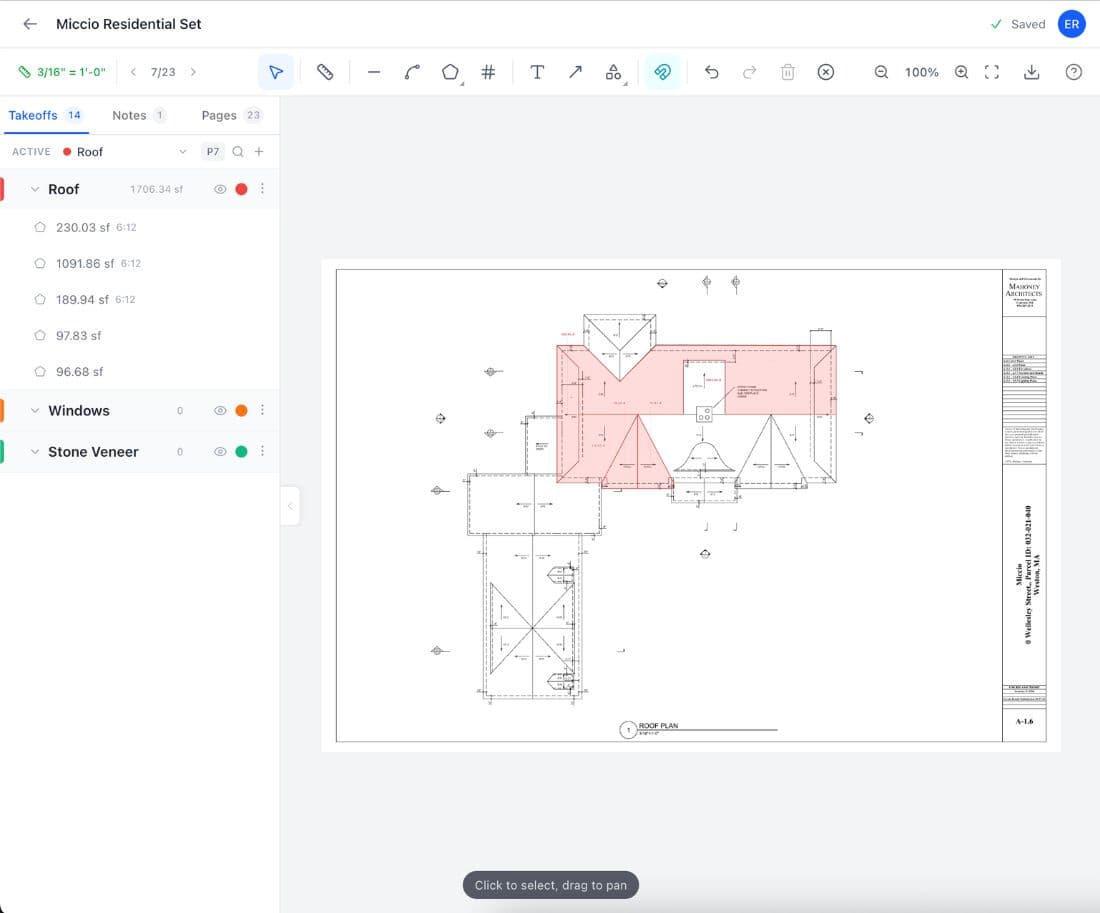
A drywall takeoff is sheet math: total wall and ceiling area, divided by sheet size, plus waste. But the details matter. A 50-room commercial tenant buildout might need 1/2-inch regular board for standard walls, 5/8-inch Type X for 1-hour rated partitions, moisture-resistant board in every restroom, and abuse-resistant board in corridors. Mix those quantities together and your material order is wrong before the truck arrives. Miss 200 square feet of ceiling area and your crew is idle while you chase a second delivery that costs $150 to $300 in shipping alone. Easy Takeoffs is drywall estimating software for $39 a month that measures wall and ceiling areas from PDF floor plans. Try every feature free for 14 days, no credit card. Trace wall perimeters with the polyline tool and multiply by ceiling height for wall board footage. Use the polygon area tool for ceiling zones. Group by board type, finish level (Level 3, Level 4, Level 5), or floor. Calculate sheet counts from your totals and export to CSV for ordering. Nothing to install, runs in any browser. Built-in templates for Drywall Walls, Drywall Ceiling, and Acoustical Ceiling Grid generate full material lists from your measurements. The Drywall Walls template calculates sheets, joint compound, tape, screws, and corner bead based on your board size. The Drywall Ceiling template does the same for ceiling installations. The Acoustical Ceiling Grid template calculates grid tees, wall angle, hanger wire, and ceiling tiles based on tile size and drop height.
Every Measurement Type
Areas, lines, counts, angles, and true curves, plus symbol search
Snap to Walls & Corners
Cursor locks to lines, corners, midpoints, and edges
Auto Scale Detection
Reads each sheet's scale; one tap confirms, one run sets every page
$39 a month
14-day free trial, no credit card, cancel any time
Any Device
Browser-based on Mac, Windows, tablet, or phone
What Is a Drywall Takeoff?
A drywall takeoff is the process of calculating the total square footage of wall and ceiling surfaces that need gypsum board, then converting that area into sheet counts, joint compound quantities, tape footage, and fastener estimates. The takeoff starts with wall perimeters (measured in linear feet from the floor plan) multiplied by ceiling height to get gross wall area. Standard opening deductions remove approximately 21 square feet per door and 12 to 15 square feet per window. Ceiling areas are measured separately because ceilings often use different board thickness, type, or finish level than walls. The sheet count calculation depends on the board size: a 4x8 sheet covers 32 square feet, a 4x10 covers 40, and a 4x12 covers 48. After adding the appropriate waste factor (10 to 15 percent depending on room complexity), you divide total area by sheet coverage and round up. A 10,000 square foot job at 12 percent waste needs 11,200 square feet of board, which is 234 sheets of 4x12. The takeoff also determines accessory quantities: approximately one 5-gallon bucket of all-purpose joint compound per 400 to 480 square feet, one box of 1-1/4 inch screws per 320 to 400 square feet, and tape footage equal to the total linear feet of all joints and corners.
How to Do a Drywall Takeoff
Upload floor plans
Upload PDF floor plans showing all wall locations, room layouts, and ceiling configurations. Multi-story projects go in the same file as separate pages. Architectural plans work best because they show wall thickness, openings, and room labels that mechanical or structural plans omit.
Trace wall perimeters by board type
Use the polyline tool to trace wall runs. Create separate measurement groups for each board type: standard 1/2-inch, 5/8-inch Type X fire-rated, moisture-resistant greenboard, and abuse-resistant board. Multiply each group total by ceiling height for gross wall area. Deduct standard openings.
Measure ceiling zones
Use the polygon area tool to trace ceiling areas by type. Standard ceilings, soffits, and bulkheads get their own groups. Ceilings below occupied floors may require Type X board for fire rating. Bathroom ceilings may need moisture-resistant board. Group each type separately.
Calculate sheet counts and export
Apply the Drywall Walls template and the sheet math happens for you: board count from your chosen sheet size, plus compound, tape, screws, and corner bead, with the waste factor visible on every material (run 10 percent for open areas, 12 standard, 15 for cut-heavy rooms) and yours to adjust per group. Export grouped quantities to CSV for material ordering by board type and delivery schedule.
Built for Drywall
Wall perimeter measurement
Trace wall runs with the polyline tool. Snap to wall corners for exact perimeter footage, then set the wall height on the group and gross wall area computes automatically. Faster and more accurate than measuring each wall segment individually on paper.
Ceiling zone areas
Measure ceiling areas with the polygon tool. Separate standard ceiling zones from soffits, bulkheads, and rated assemblies. Each zone gets its own board type and finish level for accurate ordering.
Board type and finish level grouping
Group measurements by board type (regular, Type X, moisture-resistant, abuse-resistant) and by finish level (Level 3, 4, or 5). Each group exports with separate totals so your material order matches the spec exactly.
Multi-floor project organization
Keep all floors in one project. Group by floor for phased deliveries. The elevator cannot deliver 500 sheets at once to the 8th floor. Floor-by-floor grouping lets you schedule deliveries to match the hanging sequence.
Auto scale detection
Detection reads each sheet's printed scale and offers it for one-tap confirmation, and one run can set every page in the set. Calibrate from a known dimension when a sheet has nothing to read. Each page keeps its own scale, so navigating between floors never means recalibrating.
CSV export for material ordering
Export wall area, ceiling area, and sheet counts per group to CSV. Hand the file to your supplier with board type, thickness, and quantity per delivery. The export eliminates manual transcription errors between takeoff and purchase order.
Built-in Drywall and Ceiling Templates
Apply Drywall Walls, Drywall Ceiling, or Acoustical Ceiling Grid templates to your measurement groups for automatic material lists with waste factors and rounding. Adjust properties like board size, tile size, and drop height to match your job. The templates calculate sheets, compound, tape, screws, grid components, and tiles.
Check your quantities before you bid
Each one shows the formula and a worked example so you can check the number, not just trust it. Free, no signup. For exact quantities, measure from your plans.
Drywall Waste Factors
Industry-standard waste percentages for common drywall materials. Apply these to your measured quantities for accurate ordering.
Typical Waste Factors
Shorter sheets create more joints and more cuts per room. A 12-foot wall hung horizontally needs the remaining 4 feet filled by a cut piece from another sheet. That leftover may not fit the next wall, generating 10 to 15 percent scrap. Use 4x8 only when access prevents longer sheets.
Longer sheets span more wall per piece and reduce butt joints. Waste drops to 8 to 12 percent because each sheet covers more area before a cut is needed. The savings compound on large open floor plates where long walls match the sheet length. Standard choice for 9-foot ceilings hung vertically.
Rooms under 100 square feet, corridors, closets, and areas with many openings push waste to 13 to 18 percent. Every door, window, and electrical box requires a cut, and the offcuts are often too small to use on adjacent walls. Budget 15 percent minimum for residential bathrooms and commercial corridors.
Mixing waste from dried edges in the bucket, sanding dust from finish coats, and material left in the pan at the end of each mix push compound waste to 12 to 18 percent. Hot mud (setting compound) wastes more because unused mixed material hardens and cannot be saved. Budget one 5-gallon bucket per 400 to 480 square feet of board.
Misdrives that pop the paper face, dropped screws on the floor, and stripped heads from worn driver bits waste 3 to 7 percent. A pound of 1-1/4 inch coarse-thread screws contains about 300 screws. Budget one pound per 320 to 400 square feet of board depending on framing spacing.
Tape waste comes from end cuts, torn sections from the roll, and double-layering at inside corner intersections where three surfaces meet. Mesh tape wastes slightly less because it self-adheres and does not tear from embedding pressure. Budget tape footage equal to the total linear feet of all flat joints, butt joints, and corners plus 10 percent.
Corner bead is sold in 8-foot and 10-foot sticks. Cutting to the exact height of each outside corner leaves a short remnant per stick. On a job with 30 outside corners at 9 feet, you get one 1-foot scrap per 10-foot stick. Budget 3 to 7 percent waste.
Why Drywall Contractors Need Better Takeoffs
Room-by-room calculation on 50-room projects
Calculating drywall from paper plans means measuring every wall in every room, multiplying by ceiling height, subtracting openings, converting to sheet counts, and tallying by board type. A 50-room commercial tenant buildout has 200 or more wall segments. At 2 minutes per wall, the manual takeoff takes 6 to 8 hours before you even start pricing. One transposed number in room 23 and the entire sheet count is wrong. Digital tracing completes the same takeoff in 1 to 2 hours with visible measurements on the plan that you can verify at a glance.
Mixed board types create ordering chaos
A single commercial floor might need regular 1/2-inch board on standard partitions, 5/8-inch Type X on rated walls, moisture-resistant board in restrooms and janitor closets, abuse-resistant board in corridors and lobbies, and fire-rated moisture-resistant board in the rated bathroom walls. That is 5 board types with separate sheet counts. If your takeoff does not group by type, your supplier gets one combined number and you get the wrong mix of board on the truck. A second delivery to fix the mix costs $150 to $300 in freight plus half a day of schedule delay while the hanging crew switches to a different area.
Second deliveries kill your margin
Drywall is heavy and delivery is expensive. A standard tractor-trailer carries 2,000 to 2,500 sheets. For a mid-size commercial job, you want everything on one or two deliveries. Running short by 40 sheets means a partial delivery at nearly the same freight cost, which can run $400 to $800 depending on distance. If the crew has to switch areas while waiting for board, the disruption ripples through the schedule. An accurate takeoff that gets the sheet count right on the first order is worth more than any discount on material price.
Common Drywall Takeoff Mistakes
Forgetting ceiling board in the sheet count
Wall area gets all the attention because it is the larger number, but ceiling board adds 30 to 50 percent more sheets on a typical commercial job. A 5,000 square foot floor plate needs roughly 104 sheets of 4x12 just for the ceiling. Forgetting ceilings or underestimating their area means your first delivery is 100 sheets short. Measure ceilings as a separate group using the polygon area tool. Ceilings above rated corridors may need 5/8-inch Type X, while standard office ceilings use 1/2-inch. Different board types mean different groups and separate line items on the material order.
Using gross wall area without deducting openings
Gross wall area (perimeter times height) includes the space occupied by doors, windows, and pass-throughs. On a residential floor with 15 doors and 12 windows, the openings represent 500 to 600 square feet of area you are not boarding. Over-ordering 12 sheets of 4x12 at $14 per sheet wastes $168 in material plus the stocking labor to move sheets that never get hung. Deduct 21 square feet per standard door opening and 12 to 15 square feet per window. For large openings (sliding glass doors, storefronts, garage doors), measure the actual opening area. Some estimators skip deductions and absorb the difference as extra waste factor, but on a large project the overestimate compounds.
Applying a single waste factor to every room
A 2,000 square foot open office with 12-foot ceilings and no interior walls wastes 8 percent because the long sheets span full walls with minimal cuts. A 40 square foot bathroom with a window, a door, an exhaust fan, and three walls meeting at corners wastes 18 to 20 percent because nearly every sheet gets cut and the offcuts are too small to reuse. Group rooms by complexity: open areas at 10 percent, standard rooms at 12 percent, and cut-heavy rooms (bathrooms, closets, corridors, stairwells) at 15 percent. This gives you a more accurate total sheet count than a blanket 12 percent across the entire project.
Missing rated assemblies in the board type takeoff
Building codes require fire-rated wall and ceiling assemblies at specific locations: demising walls between tenant spaces, corridor walls in commercial buildings, walls around stairwells, and ceilings below occupied floors. These assemblies typically require 5/8-inch Type X gypsum board (sometimes two layers) instead of standard 1/2-inch. Missing a rated wall means ordering regular board where Type X is required. Check the architectural reflected ceiling plan and the wall type schedule before starting your takeoff. Mark rated walls on the floor plan and create a separate measurement group for Type X board. A single-layer Type X partition needs one group. A 2-hour rated demising wall that requires two layers of 5/8-inch Type X on each side needs the wall area doubled in your calculation.
Ignoring the board delivery and stocking sequence
Your takeoff sheet count determines the delivery order, and the delivery order determines whether the job runs smoothly or grinds to a halt. If you order all 500 sheets at once but the elevator can only handle 20 sheets per load, stocking the 8th floor takes a full day of elevator time that every other trade needs. Break your takeoff by floor and by area within each floor. Export sheet counts per floor so deliveries can be staged. On high-rise projects, some contractors stock by boom from the exterior before the building is enclosed. The takeoff needs to identify which floors and which board types need early delivery for the stocking sequence to work.
Drywall Takeoff Pro Tips
Measure wall perimeters, not individual walls
New estimators measure each wall segment individually: north wall 14 feet, east wall 12 feet, south wall 14 feet, west wall 12 feet. This is slow and error-prone. Instead, trace the entire room perimeter as a single polyline. The total perimeter (52 feet in this example) multiplied by ceiling height gives gross wall area in one calculation. This approach works because drywall is ordered by total area, not by individual wall dimensions. The sheet count from 52 linear feet at 9-foot height (468 square feet, 10 sheets of 4x12) is the same regardless of how the footage breaks across individual walls. For rooms with different board types on different walls (like a bathroom with moisture-resistant board on wet walls and regular board on dry walls), trace the wet-wall perimeter separately in a moisture-resistant group and the remaining perimeter in the standard group.
Use the finish schedule to drive your board type groups
The architectural finish schedule lists every room by number, name, floor finish, wall finish, and ceiling finish. The wall finish column tells you the finish level. Level 3 areas (mechanical rooms, above ceilings) need basic taping with no skim coat. Level 4 (most offices and residences) needs standard taping and one skim coat. Level 5 (high-end lobbies, areas with gloss paint or critical lighting) needs a full skim coat over the entire surface. Finish level affects labor cost more than material cost, but it determines your joint compound quantity. Level 5 finishing uses 30 to 40 percent more compound per square foot than Level 4. If your takeoff groups by finish level, your compound order and labor estimate are both more accurate. Cross-reference the finish schedule with the fire rating schedule. A room might need Type X board for the fire rating AND Level 5 finishing for the aesthetic. That wall goes in a "Type X / Level 5" group so you order the right board and budget the right labor.
Calculate joint compound and tape from board area
Experienced estimators use these rules of thumb: one 5-gallon bucket of all-purpose joint compound covers 400 to 480 square feet of board (all three coats combined), one roll of paper tape covers about 500 linear feet of joints, and one box of screws covers 320 to 400 square feet depending on stud spacing (12-inch vs 16-inch on center). For more precise compound estimates, calculate the total linear feet of flat joints (seams between sheets), butt joints, inside corners, and outside corners. Flat joints take the most compound per linear foot. A 4x12 sheet hung horizontally on a wall creates one 12-foot flat joint on top and one on the bottom. Multiply the number of sheets by 2 times the sheet length for a rough flat-joint total. Do not forget that ceiling joints use more compound per foot than wall joints because the compound must resist gravity and tends to be applied thicker. Budget 10 to 15 percent more compound for ceiling work than wall work per square foot.
Account for double-layer assemblies separately
Some fire-rated and sound-rated assemblies require two layers of gypsum board on one or both sides of the wall. A 2-hour fire-rated demising wall (UL Assembly U411, for example) needs two layers of 5/8-inch Type X on each side. That means the wall area is multiplied by 4 for total sheet count, not 2. Create separate measurement groups for single-layer and double-layer assemblies. A single polyline trace of the demising wall perimeter gives you the base footage. Multiply by ceiling height for the wall area of one side. Then multiply by 2 for both sides, and by 2 again for the double layer, giving you 4x the single-face area. Double-layer assemblies also need more screws (the base layer uses longer screws than the face layer) and potentially different screw patterns. The base layer might be 12 inches on center while the face layer is 8 inches. Your takeoff group for double-layer walls should note the assembly type so the ordering and labor pricing account for the additional fasteners.
Group by delivery phase on large projects
On a 200-unit apartment complex or a 10-story commercial building, the entire project board count might be 8,000 to 15,000 sheets. No contractor orders all of that at once. Deliveries are phased by floor, by building, or by construction phase (framing, boarding, finishing). Set up your takeoff groups with a delivery prefix: "Bldg A FL1 Standard 1/2," "Bldg A FL1 Type X 5/8," and so on. When you export to CSV, each row represents a delivery line item. The supplier can quote per-delivery pricing and schedule trucks to match your hanging crew progression through the building. This also prevents the most common large-project disaster: running out of one board type while having a surplus of another. If Building A needs 60 percent regular board and 40 percent Type X, but Building B needs 80/20, the combined order hides the imbalance. Delivery-phased groups keep each location accurate independently.
Drywall Takeoff Questions
Start Your Construction Takeoff Today
Upload your plans, measure your quantities, and export the results. Try the full software for 14 days, then choose $39 a month or $399 a year.