Insulation Takeoff Software
Measure wall cavities, ceiling zones, and floor areas for fiberglass batts, blown-in cellulose, and spray foam with built-in material templates. Group by R-value and insulation type. Export batt counts and board-foot quantities. $39 a month, cancel any time.
Insulation Takeoffs, Simplified
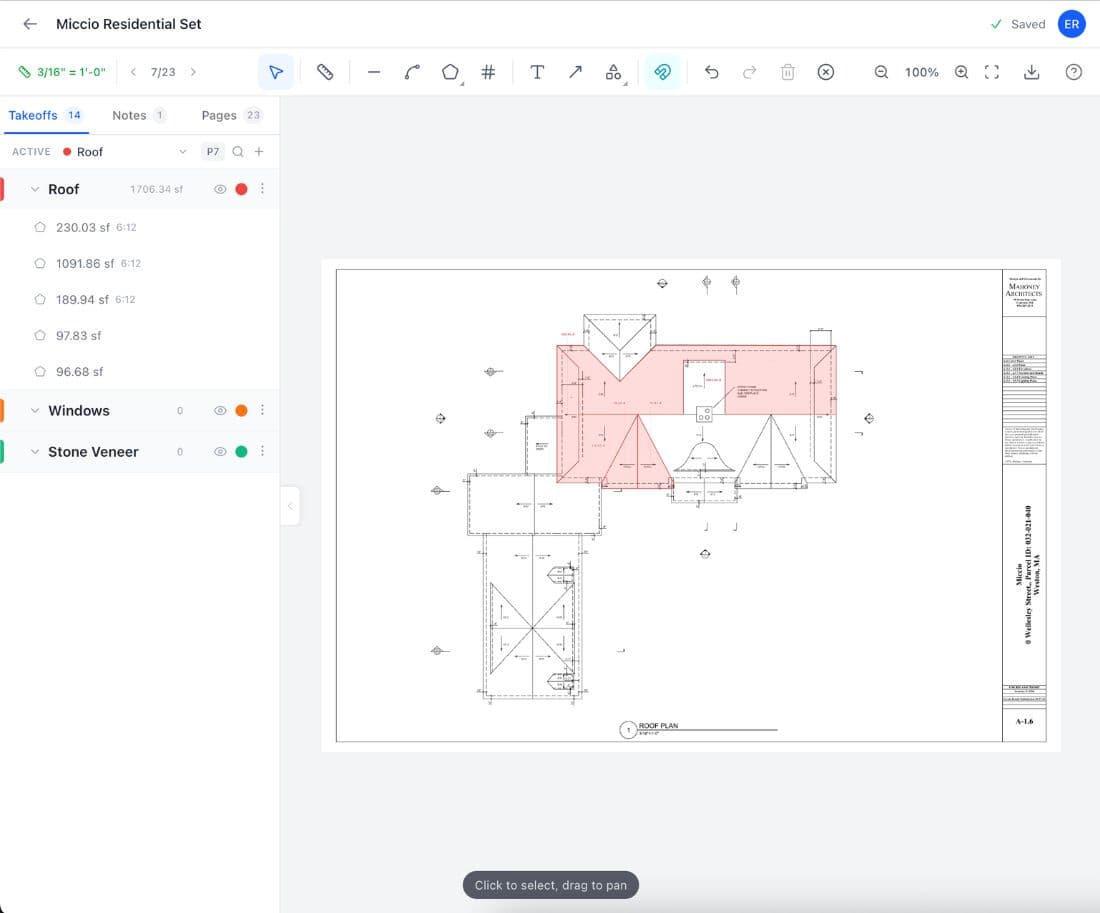
An insulation takeoff converts floor plans into area measurements for every insulated surface: exterior walls, interior sound walls, attic floors, cathedral ceilings, crawl space floors, and rim joists. Each surface has a different R-value requirement, a different insulation product, and a different coverage rate per bag, roll, or board foot. A 3,000 square foot house might need R-13 batts in interior sound walls, R-21 batts in 2x6 exterior walls, R-49 blown cellulose in the attic, and 2 inches of closed-cell spray foam on the rim joists. Mix up the R-values or underestimate the area and you are either short on material or short on code compliance. Easy Takeoffs is an insulation quantity calculator and takeoff tool for $39 a month that measures wall and ceiling areas from PDF plans. Try every feature free for 14 days, no credit card. Trace wall perimeters with the polyline tool and multiply by wall height for cavity area. Use the polygon area tool for ceiling and floor zones. Group by R-value, insulation type (batt, blown, spray foam), or building zone. Export all quantities to CSV for ordering. Nothing to install, runs in any browser. Built-in templates for Insulation Batt, Blown-In Insulation, and Spray Foam Insulation generate material quantities from your measurements. The Insulation Batt template calculates batt bags and optional vapor barrier from your area and R-value. The Blown-In Insulation template handles bag counts based on material type, target R-value, and rafter spacing, with optional eave baffles. The Spray Foam Insulation template calculates board feet and ignition barrier based on foam type and thickness.
Every Measurement Type
Areas, lines, counts, angles, and true curves, plus symbol search
Snap to Walls & Corners
Cursor locks to lines, corners, midpoints, and edges
Auto Scale Detection
Reads each sheet's scale; one tap confirms, one run sets every page
$39 a month
14-day free trial, no credit card, cancel any time
Any Device
Browser-based on Mac, Windows, tablet, or phone
What Is a Insulation Takeoff?
An insulation takeoff is the process of measuring every wall, ceiling, and floor surface that requires insulation, then calculating the quantity of material needed to fill those cavities to the specified R-value. The takeoff starts with wall perimeters (linear feet from the floor plan) multiplied by wall height to get gross cavity area. Ceiling insulation uses the plan-view floor area of the space below (the attic footprint for blown-in attic insulation, or the ceiling area for cathedral ceilings with batts between rafters). The material quantity calculation depends on the insulation type. Fiberglass batts are sold by the bag, with each bag covering a specific square footage at a given stud spacing. An R-19 kraft-faced batt sized for 16-inch on-center framing covers about 48.96 square feet per bag. Blown-in cellulose is sold by the bag, with coverage per bag depending on the target R-value and settled thickness. At R-38 (approximately 10.25 inches settled depth), a standard bag covers about 27 to 32 square feet. Spray foam is priced by the board foot (one square foot at one inch thick), so a 2-inch application on 1,000 square feet requires 2,000 board feet. The takeoff must capture area by zone and R-value so each product quantity can be calculated independently.
How to Do a Insulation Takeoff
Upload floor plans or framing plans
Upload PDF floor plans, framing plans, or building sections. Exterior wall insulation, interior partition insulation, attic insulation, and crawl space insulation may appear on different sheets. Upload all relevant pages in one project so you can switch between them while measuring.
Trace wall perimeters by R-value
Use the polyline tool to trace exterior wall perimeters in one group (R-21 for 2x6 walls, for example) and interior sound walls in another group (R-13 for 2x4 partitions). Multiply each group total by wall height for gross cavity area. The polyline snaps to wall corners for precise perimeter footage.
Measure ceiling, attic, and floor zones
Use the polygon area tool to trace attic insulation zones (the footprint below the attic space), cathedral ceiling areas between rafters, and crawl space floor insulation zones. Create separate groups for each R-value: R-38 attic, R-49 attic, R-30 cathedral ceiling, R-19 crawl space floor.
Calculate quantities and export
Apply the insulation templates and the coverage math happens for you: bags of batts, bags of blown-in at your target depth, or board feet of spray foam, each with its waste factor visible and adjustable per group. Export grouped quantities to CSV for ordering with your supplier.
Built for Insulation
Wall cavity area measurement
Trace exterior and interior wall perimeters with the polyline tool, then set the wall height on the group and gross cavity area computes automatically. Separate 2x4 walls (R-13) from 2x6 walls (R-21) and double-stud walls (R-38) in different groups.
Ceiling and floor zone areas
Measure attic insulation footprints, cathedral ceiling areas, crawl space floors, and slab-edge perimeters with the polygon area tool. Each zone gets its own R-value group for accurate product ordering.
R-value and product grouping
Group by both R-value and insulation type. R-21 fiberglass batts and R-21 spray foam cover the same R-value but use completely different products with different pricing and coverage rates. Separate groups prevent ordering errors.
Multi-zone project organization
Keep all building zones in one project. A house might have 6 insulation zones: exterior walls, interior sound walls, attic floor, cathedral ceiling over the great room, crawl space floor, and rim joists. Each zone is a group with its own area and R-value.
Auto scale detection
Detection reads each sheet's printed scale and offers it for one-tap confirmation, with one run that can set every page, or calibrate from a known wall dimension. Floor plans and building sections often use different scales, and per-page scales handle this cleanly.
CSV export for material ordering
Export area per group to CSV. Calculate batt bags, cellulose bags, or spray foam board feet from the exported areas using the product coverage rate. The CSV drops directly into your ordering spreadsheet or supplier quote request.
Built-in Insulation Templates
Apply Insulation Batt, Blown-In Insulation, or Spray Foam Insulation templates to your measurement groups for automatic material lists with waste factors and rounding. Adjust properties like R-value, material type, foam thickness, and whether to include vapor barrier or eave baffles to match your job.
Insulation Waste Factors
Industry-standard waste percentages for common insulation materials. Apply these to your measured quantities for accurate ordering.
Typical Waste Factors
Batts are pre-sized to fit 16-inch or 24-inch on-center framing, so straight cavity runs waste very little. The 3 to 7 percent accounts for trimming around electrical boxes, plumbing penetrations, window and door headers, and irregular framing at corners. Faced batts tear more easily during trimming, adding slightly more waste than unfaced.
Cathedral ceilings with variable rafter lengths (hip and valley framing) require cutting each batt to a different length. The tapered sections near the ridge and eave generate offcuts too small to use in the next rafter bay. Budget 6 to 10 percent waste depending on roof geometry. Simple gable roofs waste less; hip roofs waste more.
Cellulose settles 15 to 20 percent after installation, so manufacturers specify an initial installed depth greater than the settled depth. Overfill to account for settling, plus spillage at eave baffles and around attic access openings, pushes material usage to 8 to 12 percent above the calculated coverage. Temperature and humidity affect blowing density and actual bag coverage.
Dense-pack cellulose in closed wall cavities requires 3.5 pounds per cubic foot density to prevent settling. The drill-and-fill process wastes material at each hole location and during the initial pressurization of each cavity. Irregular framing (fire blocking, diagonal bracing in older homes) traps material in pockets that overfill before the rest of the cavity is full. Budget 10 to 15 percent.
Closed-cell spray foam yield depends on ambient temperature, substrate temperature, and gun technique. Cold substrates reduce chemical reaction efficiency, meaning more material for the same thickness. Overspray on adjacent surfaces that must be trimmed, plus the shaving waste when scraping foam flush with studs for drywall installation, adds 8 to 12 percent to the calculated board-foot quantity.
Open-cell foam expands more aggressively than closed-cell and must be trimmed flush with the stud face. The trimmed material is waste. On cathedral ceilings and irregular rafter bays, trimming waste can reach 15 percent because the foam fills the deep cavity and then expands past the rafter face. Budget 10 to 15 percent depending on cavity depth and regularity.
Rigid boards come in 4x8 sheets. Cutting around windows, doors, electrical penetrations, and at odd-width wall sections generates offcuts. Fragile boards crack during handling and cutting, creating waste from damaged pieces. Polyiso foil facers tear, and damaged boards cannot be patched. Budget 5 to 10 percent depending on wall geometry and opening density.
Why Insulation Contractors Need Better Takeoffs
Multiple R-values on a single building
A single house under the 2021 IECC in Climate Zone 5 might require R-20 or R-13 plus 5 continuous on exterior walls, R-49 in the attic, R-30 in cathedral ceilings, R-19 in floors over unconditioned spaces, and R-10 on basement walls. That is 5 different R-values using 3 or 4 different insulation products. Without grouped takeoffs, the areas get combined into a single number and you cannot order the right quantity of each product. A shortfall of 300 square feet of R-49 blown cellulose means a second trip with the blowing machine, crew time, and a $200 to $400 material reorder. Grouped digital measurements prevent this by keeping each R-value separate from the start.
Vapor barrier and air sealing quantities missed
Insulation inspectors fail jobs for missing vapor barriers and air sealing, not only missing insulation. Polyethylene vapor barrier (6-mil poly) is measured by the square foot of wall and ceiling area it covers, plus overlap at seams. Acoustic sealant for air sealing is measured by the linear foot of every wall-to-floor, wall-to-ceiling, and wall-to-wall joint. Manual takeoffs focus on the insulation itself and forget these accessories. A 3,000 square foot house might need 4,500 square feet of poly (walls plus ceiling with 6-inch overlaps) and 800 linear feet of sealant. Missing the vapor barrier order delays the insulation inspection.
Coverage rates vary by product and stud spacing
An R-19 kraft-faced batt at 16-inch on-center covers 48.96 square feet per bag (Owens Corning). The same R-19 batt at 24-inch on-center covers 67.8 square feet per bag because the wider spacing means fewer batt pieces per linear foot of wall. Blown-in cellulose coverage per bag changes with target R-value: at R-30 a standard bag covers about 37 square feet, but at R-49 the same bag covers only 22 to 27 square feet because the depth is greater. If your takeoff does not separate areas by R-value and stud spacing, your bag count calculation is wrong.
Common Insulation Takeoff Mistakes
Measuring gross wall area instead of cavity area
Gross wall area includes the area occupied by studs, plates, headers, and other framing members that the insulation does not fill. Standard wood framing has a framing factor of 20 to 25 percent, meaning only 75 to 80 percent of the wall is actual cavity. On a wall with 2,000 square feet of gross area, the cavity area is 1,500 to 1,600 square feet. In practice, most insulation contractors order based on gross area because batts are manufactured to fit between studs and the stud width is part of the batt dimension. But for spray foam and blown-in pricing, the framing factor matters because you are paying per board foot or per cubic foot of material that only fills the cavities. Using gross area for spray foam quantity overestimates material by 20 to 25 percent.
Using the wrong coverage rate for the stud spacing
Fiberglass batt coverage per bag depends on the stud spacing. A bag of R-19 batts at 16-inch on-center contains fewer, narrower batts that cover about 49 square feet. The same R-value at 24-inch on-center contains wider batts covering about 68 square feet per bag. Ordering 16-inch batts for 24-inch framing means every batt is too narrow and leaves gaps. Ordering 24-inch batts for 16-inch framing means they do not fit without compression, which reduces the R-value. Verify the framing spacing on the structural plans before ordering. Exterior walls are commonly 16-inch on-center, but some builders use 24-inch for advanced framing (optimized value engineering). Interior partitions vary. Getting the spacing wrong on the order is a common and expensive mistake.
Forgetting rim joist and band board insulation
The rim joist (band board) at each floor level is one of the biggest sources of air leakage and heat loss in a house, but it is not visible on a standard floor plan view. The rim joist area equals the building perimeter (in linear feet) multiplied by the joist depth (typically 9.25 inches for a 2x10 or 11.875 inches for an engineered I-joist). For a house with 160 linear feet of perimeter, the rim joist area is approximately 123 to 158 square feet per floor. Rim joists are typically insulated with 2 inches of closed-cell spray foam or rigid foam board cut to fit each joist bay. Missing this area from your takeoff means a failed energy code inspection and a callback to insulate it. Include a separate measurement group for rim joists by tracing the building perimeter and noting the joist depth.
Not accounting for cathedral ceiling depth limitations
Cathedral ceilings with 2x8 rafters have only 7.25 inches of cavity depth. After subtracting the 1-inch minimum ventilation space required above the insulation (per IRC R806.3), you have 6.25 inches available. An R-30 fiberglass batt is 9.5 inches thick, which will not fit. You either compress it (reducing its R-value) or switch to a higher-density product like closed-cell spray foam (R-6.5 per inch, giving R-40 in 6.25 inches). Your takeoff must note the rafter depth for cathedral ceiling zones so the insulation type and thickness can be specified correctly. A zone marked "R-30 cathedral" means nothing if the cavity cannot physically hold R-30 batts. The product selection depends on the available depth, and the cost difference between compressed batts and spray foam is significant.
Ignoring code-required continuous insulation on exteriors
The 2021 IECC requires continuous insulation (ci) on exterior walls in most climate zones. In Zone 4, the requirement is R-13 cavity plus R-5 continuous, or R-20 cavity alone. In Zone 5, it is R-20 cavity plus R-5 continuous, or R-13 cavity plus R-10 continuous. Continuous insulation is rigid foam board or mineral wool installed on the exterior sheathing, outside the framing. This is a completely separate insulation scope from the cavity insulation. The area equals the total exterior wall area (not just cavity area, since the rigid board covers studs too). Many insulation contractors miss this scope because it is installed at a different phase (before siding, not during framing). Create a separate measurement group for continuous insulation with its own area and product type.
Insulation Takeoff Pro Tips
Group by insulation product, not just R-value
R-value tells you the thermal performance target, but product type determines what you order. R-21 can be fiberglass batts (standard), mineral wool batts (Rockwool ComfortBatt), or closed-cell spray foam at 3 inches. Each product has different pricing, different coverage per unit, and different installation crews. A fiberglass batt crew and a spray foam crew are different trucks, different equipment, and often different subcontractors. Create measurement groups that combine R-value and product: "R-21 Fiberglass Batt Ext Walls," "R-49 Blown Cellulose Attic," "R-10 Closed-Cell Spray Foam Rim Joists." The CSV export then gives you one line per product for ordering. This also helps with scheduling. Spray foam must be applied before drywall but after electrical and plumbing rough-in. Batts can go in anytime before drywall. Blown-in cellulose in attics can go in after drywall. Product-based groups let you sequence the work correctly.
Measure attic insulation from the floor plan, not the roof plan
Blown-in attic insulation sits on the attic floor (the ceiling of the rooms below), not on the roof surface. The area you need is the footprint of the conditioned space below the attic, measured from the floor plan. This is the same as the ceiling area for the top floor. Do not measure the roof surface area for attic insulation. The roof is larger than the floor due to pitch and overhangs. A 1,500 square foot attic floor under a 6/12 pitch roof has about 1,677 square feet of roof surface. Using the roof area overestimates cellulose by 12 percent. For cathedral ceilings (insulation between rafters), you DO measure the rafter surface area, which is larger than the floor plan area due to pitch. A 6/12 pitch adds about 12 percent to the plan-view area. Use the slope factor for the roof pitch to convert plan-view area to actual rafter surface area.
Include air sealing quantities in your insulation takeoff
Energy code inspections check air sealing and insulation together. If you bid the insulation but miss the air sealing scope, you either eat the cost or submit a change order. The air sealing quantities come from the same measurements as the insulation: wall perimeters and ceiling areas. Acoustic sealant (caulk) is needed at every top plate (perimeter of every wall at the ceiling line), every bottom plate (perimeter of every wall at the floor), and every penetration (electrical boxes, plumbing, HVAC). Measure the total wall perimeter for top and bottom plate sealing. Count penetrations for tube estimates. A typical 2,500 square foot house needs 800 to 1,200 linear feet of sealant and 15 to 25 tubes of acoustical caulk. Foam sealant (cans of Great Stuff or equivalent) is needed at windows, doors, pipe penetrations, and duct penetrations. Count the openings from the plan for can estimates.
Verify R-value requirements by climate zone before takeoff
The International Energy Conservation Code (IECC) sets minimum R-values by climate zone. Before starting your takeoff, check the project location climate zone and the applicable code edition (2018, 2021, or local amendments). The R-value requirements determine which measurement groups you need. For example, in IECC 2021 Climate Zone 5: ceilings require R-49, wood-frame walls require R-20 or R-13 plus R-10 continuous, floors over unconditioned spaces require R-30, basement walls require R-15 or R-19, and slab edge requires R-10 to a depth of 4 feet. That is 5 zones with 5 different R-values, each needing its own measurement group. Some jurisdictions allow trade-offs under the Total UA Alternative (Section R402.1.5), where you can reduce insulation in one area if you increase it in another. The takeoff needs to match whatever the energy compliance path specifies, which may differ from the prescriptive table values.
Calculate board feet for spray foam from area and thickness
Spray foam contractors price by the board foot: one square foot of coverage at one inch of thickness. If the spec calls for 2 inches of closed-cell foam on 1,000 square feet of wall, the quantity is 2,000 board feet. At 3 inches on 500 square feet of rim joist, it is 1,500 board feet. The board-foot calculation is simple, but the yield is not. Spray foam chemical sets (A-side and B-side drums) have a theoretical yield in board feet, but real-world yield depends on substrate temperature, ambient temperature, application technique, and cavity irregularity. Cold-weather applications can reduce yield by 10 to 15 percent. Add 10 percent waste to the theoretical quantity for standard conditions and 15 percent for cold-weather or complex cavity work. Your takeoff should capture area per zone and the specified thickness. The board-foot calculation (area times thickness) and the waste factor give you the order quantity. Separate groups for different thicknesses (2-inch walls vs 3-inch rim joists) keep the math clean.
Insulation Takeoff Questions
Start Your Construction Takeoff Today
Upload your plans, measure your quantities, and export the results. Try the full software for 14 days, then choose $39 a month or $399 a year.