Fencing Takeoff Software
Trace fence lines on site plans for exact linear footage with a built-in Wood Fence material template. Count posts, gates, corners, and terminals. Separate runs for wood privacy, chain link, ornamental iron, and vinyl. Export material lists. $39 a month, 14-day free trial, no credit card.
Fencing Takeoffs, Simplified
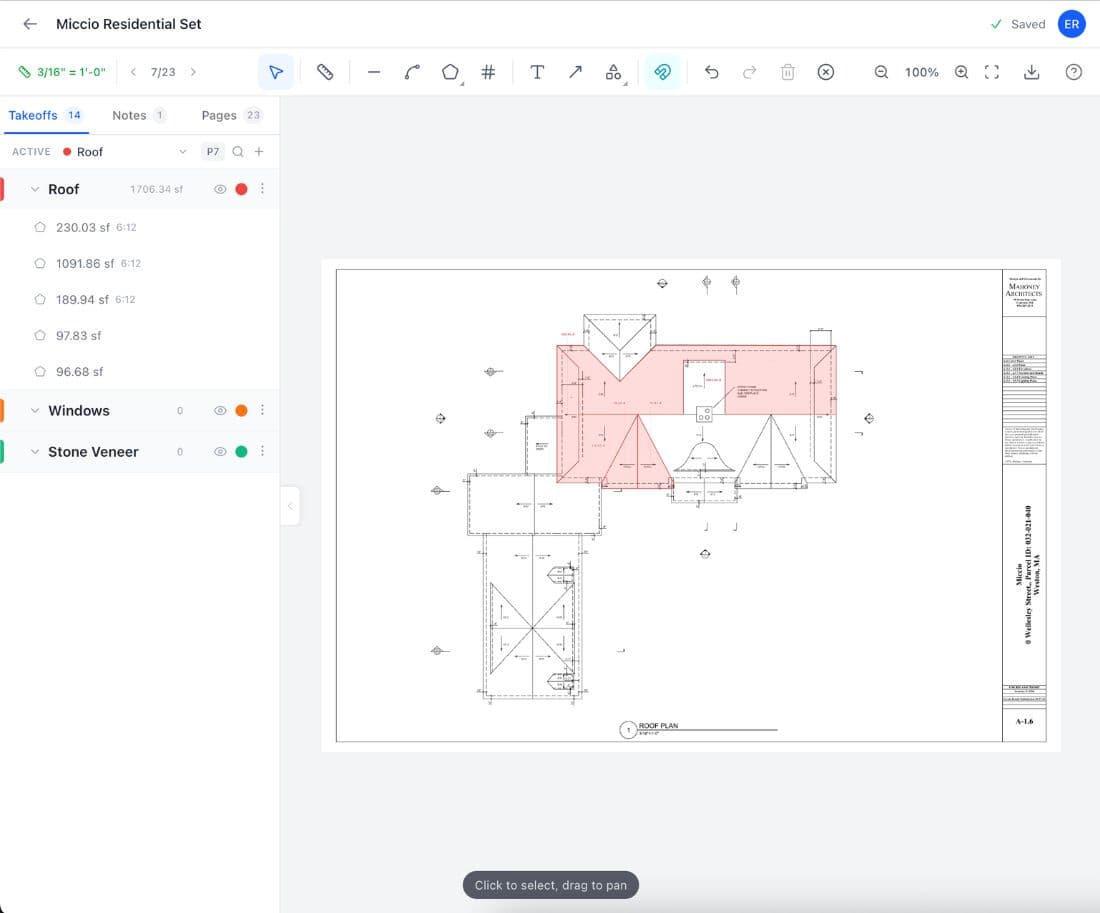
A fencing takeoff is linear footage and post counts. Every material calculation flows from those two numbers: pickets per foot of privacy fence, rolls of chain link fabric per total footage, rail sticks per section, and concrete bags per post hole. A 400-foot residential perimeter fence with 3 gates, 8 corners, and mixed fence types (privacy on three sides, chain link across the back) requires precise footage per type to order correctly. Short the chain link fabric by one roll and the crew waits while you drive to the supply house. Over-order pickets by 10 percent on a 600-foot privacy job and $300 to $500 in cedar sits in your shop. Easy Takeoffs is fencing bid software for $39 a month that lets you trace fence lines on PDF site plans with the polyline tool, counting every post, gate, corner, and end with the count tool. Try every feature free for 14 days, no credit card. Group by fence type: 6-foot cedar privacy, 4-foot residential chain link, 8-foot commercial chain link, ornamental aluminum, vinyl, split rail, or temporary construction fencing. Export all quantities to CSV for pricing with your supplier. The built-in Wood Fence template generates a full material list from your measured fence footage. It calculates posts, rails, pickets, concrete bags, post caps, and screws based on your fence height, post spacing, and picket width. Adjust any property to match your specific fence design and the template recalculates everything automatically.
Every Measurement Type
Areas, lines, counts, angles, and true curves, plus symbol search
Snap to Walls & Corners
Cursor locks to lines, corners, midpoints, and edges
Auto Scale Detection
Reads each sheet's scale; one tap confirms, one run sets every page
$39 a month
14-day free trial, no credit card, cancel any time
Any Device
Browser-based on Mac, Windows, tablet, or phone
What Is a Fencing Takeoff?
A fencing takeoff is the process of measuring the total linear footage of each fence run, counting all posts by type (line, corner, end, gate), and listing every gate by size and style from a site plan or survey before bidding or ordering material. The takeoff captures three categories of quantities: linear measurements (total footage for rails, pickets, mesh fabric, or panels), counts (line posts, corner posts, end posts, gate posts, gates, and terminal fittings), and derived calculations (pickets from footage, concrete from post count, fasteners from rail count). Fence lines follow property boundaries, setback lines, and landscape features that create irregular paths with jogs, angles, and offsets. A straight backyard property line is simple to measure, but a perimeter fence that follows a curved driveway, jogs around a septic field, and offsets 6 inches inside the property line at a neighbor dispute requires careful tracing. Without accurate fencing estimating software or careful manual measurement, the linear footage error cascades directly into the material order. Picket count is a direct function of footage (approximately 2.3 pickets per linear foot for standard 3.5-inch dog-eared cedar with 1.75-inch gaps). Post count depends on footage, spacing, and the number of corners, ends, and gates. Getting the footage wrong cascades through every material calculation.
How to Do a Fencing Takeoff
Upload site plan or survey
Upload the PDF site plan, survey plat, or landscape plan showing property lines and fence locations. Civil site plans typically show fence lines as dashed lines with fence type labels. Survey plats show property boundaries and setback lines. Set the scale using a known property line dimension or the drawing scale bar.
Trace fence lines by type
Use the polyline tool to trace each fence run. Create separate measurement groups for each fence type: "6-ft Cedar Privacy," "4-ft Chain Link," "Ornamental Iron Gate Section." Click at every corner, direction change, and gate location. The tool calculates total and per-segment linear footage for each group.
Count posts, gates, and terminals
Use the count tool to mark every post location. Create groups for line posts, corner posts, end posts, and gate posts. Mark each gate opening with its size (3-foot walk gate, 12-foot double drive gate). For chain link, mark terminal posts (end, corner, gate) separately from line posts because they use different hardware.
Export and calculate materials
Export linear footage and post counts to CSV. The Wood Fence template turns footage into pickets, rails, post caps, screws, and concrete bags per hole for you, with the waste factor visible and adjustable. Each fence type exports separately for clean material ordering.
Built for Fencing
Fence line measurement
Trace fence runs on site plans with the polyline tool. Click at every corner, gate, and direction change, and bow any segment into a true arc where the line follows a curved driveway or radius property corner, with the length computed from real arc math. Total and per-segment footage are calculated automatically.
Post and gate counting
Count line posts, corner posts, end posts, gate posts, and gate openings with the count tool, or box one post symbol and inspect the confirmed matches before bulk addition. Each marker sits on the plan so you can verify spacing visually. Separate count groups for each post type prevent mix-ups between 4x4 line posts and 6x6 gate posts.
Fence type grouping
Group by fence type: 6-foot cedar privacy, 4-foot chain link, ornamental iron, vinyl, split rail, temporary construction fencing. Each type uses completely different materials, so separate groups prevent ordering errors and produce clean bid line items.
Multi-property project support
Subdivision and HOA fence projects with dozens of lots can be organized with lot-number groups. Trace each lot fence line separately. Export per-lot quantities for individual invoicing or combined totals for bulk material ordering.
Auto scale detection
Site plans often use different scales than architectural plans. Detection reads the printed scale and offers it for one-tap confirmation, or calibrate from a known property line dimension. Common site plan scales: 1 inch equals 20 feet, 1 inch equals 30 feet, or 1 inch equals 50 feet.
CSV export for material ordering
Export fence footage, post counts, and gate sizes to CSV. Calculate pickets, rails, fabric rolls, and concrete from the exported numbers. Hand the CSV to your supplier for a line-by-line material quote.
Built-in Wood Fence Template
Apply the Wood Fence template to your measurement groups for automatic material lists with waste factors and rounding. The template calculates posts, rails, pickets, concrete bags, post caps, and screws based on your fence height, post spacing, and picket width. Adjust any property to match your fence design.
Check your quantities before you bid
Each one shows the formula and a worked example so you can check the number, not just trust it. Free, no signup. For exact quantities, measure from your plans.
Fencing Waste Factors
Industry-standard waste percentages for common fencing materials. Apply these to your measured quantities for accurate ordering.
Typical Waste Factors
Defective boards from the lumber yard (splits, excessive wane, warping) account for 3 to 5 percent. Cut waste at gate openings, corners, and the end of each run adds another 2 to 5 percent. Cedar boards have more natural defects than pressure-treated pine, pushing cedar waste toward 10 percent. Always hand-sort the delivery and reject visibly defective boards before stacking.
Chain link fabric comes in 50-foot rolls. A 120-foot run uses 2.4 rolls, so you buy 3 rolls and have 30 feet of remnant. On long straight runs, waste is minimal. On properties with many short segments (under 50 feet each), the roll remnants accumulate. Budget 2 to 5 percent. The fabric itself does not generate cut waste because it stretches to fit, but tension bars and tie wires at each terminal post add a small fixed amount per section.
Wood rails come in 8-foot, 10-foot, or 16-foot lengths. A fence section that lands at 7 feet between posts leaves a 1-foot scrap from an 8-foot stick, or a 3-foot scrap from a 10-foot stick. On a 200-foot run at 8-foot post spacing with 25 sections, the remnants add up to 3 to 7 percent waste. Steel top rails for chain link come in 21-foot lengths (10.5 feet per sleeve joint), and the waste pattern is similar: the last section of each straight run leaves a remnant.
Post holes dug by auger are rarely perfectly cylindrical. Rocky soil, clay that crumbles, and root disturbance enlarge the hole, consuming more concrete than the calculated volume. A standard 10-inch diameter by 36-inch deep hole holds about 0.45 cubic feet of concrete (roughly one 80-pound bag of premix). Oversized holes and spillage push actual usage to 1.2 to 1.5 bags per hole. Budget 8 to 12 percent above the calculated footing concrete.
Vinyl panels come in pre-assembled 6-foot or 8-foot sections. There is no cut waste on straight runs because panels are designed to fit between posts at standard spacing. Waste comes from damaged panels during shipping or installation (vinyl cracks in cold weather) and from short runs that require cutting a panel to fit. Budget 2 to 5 percent.
Ornamental panels come in 6-foot or 8-foot pre-welded sections. Runs that do not divide evenly by the panel width require a custom-cut filler panel. Filler panels waste the remainder of the cut section. On properties with many short runs and angles, filler waste increases. Budget 3 to 7 percent depending on lot geometry.
Why Fencing Contractors Need Better Takeoffs
Irregular lot shapes make manual measurement slow
Residential lots are rarely perfect rectangles. Property lines jog around easements, curve along cul-de-sacs, angle at odd-shaped lots, and offset at setback requirements. Scaling each segment individually from a paper site plan takes 20 to 30 minutes for a single lot and compounds errors at every segment. A 400-foot perimeter with 12 direction changes has 12 opportunities for a 6-inch scaling error, which can add up to 6 feet of cumulative error, enough to be short one 8-foot panel on a vinyl fence job. That panel costs $40 to $80 and requires a second trip to the supply house. Digital tracing with the polyline tool captures the exact path, including curves and angles, and sums the footage automatically.
Post count math gets wrong at corners and gates
The basic post formula (linear footage divided by spacing plus one) only works for a single straight run with no gates. Every corner adds a post. Every gate adds two posts (one on each side of the opening). Every end of run adds a post. A perimeter fence with 8 corners, 3 gates, and 2 end runs adds 16 extra posts beyond the line post count. At $15 to $25 per pressure-treated 4x4 post and $8 to $15 per bag of concrete, those 16 posts represent $370 to $640 in material. Miss them in your bid and you either eat the cost or look unprofessional sending a change order for posts the homeowner can count on the plan.
Mixed fence types complicate the material order
A typical residential job might have 6-foot cedar privacy on three sides (250 feet), 4-foot chain link across the back (120 feet), an ornamental iron walk gate at the front (4 feet), and a double-drive gate for the driveway (12 feet). That is 4 fence types with completely different materials: cedar pickets and 2x4 rails for the privacy section, galvanized fabric and top rail for the chain link, welded aluminum panels for the ornamental section, and gate hardware kits for both gate types. Without grouped measurements, these quantities get tangled into a single footage number that means nothing at the supply counter. Grouped digital takeoff produces separate line-item quantities for each fence type, ready for the material order.
Common Fencing Takeoff Mistakes
Measuring to the property line instead of the fence line
Most municipalities require fences to be set 6 inches to 2 feet inside the property line, and many homeowners set fences on the property line by agreement with neighbors. The fence line on the site plan may not match the property boundary shown on the survey. If you measure to the property boundary but the fence is offset inside by 1 foot on all sides, a 100x100 foot lot measures 400 feet on the property line but only 392 feet on the fence line. That 8-foot difference is one fence section. Always trace the fence line as shown on the approved site plan, not the property boundary. If the plan does not specify the offset, clarify with the homeowner before bidding. The offset distance affects total footage, corner post locations, and gate placement.
Forgetting gate posts are larger than line posts
Gate posts carry the weight of the gate and the stress of opening and closing. A standard 4x4 line post is not strong enough for a gate over 4 feet wide. Walk gates (3 to 4 feet) typically need 4x4 or 4x6 gate posts. Single drive gates (5 to 6 feet) need 6x6 posts. Double drive gates (10 to 16 feet) need 6x6 posts or steel pipe set in concrete. The material cost difference between a 4x4 and a 6x6 pressure-treated post is $10 to $20 per post, and the hole size and concrete quantity increase accordingly. Create a separate count group for gate posts with the post size noted. If your takeoff counts all posts as 4x4, the gate posts are undersized, the gate sags within a year, and you get a callback.
Using 8-foot post spacing on sloped ground
Standard 8-foot post spacing works on flat ground. On slopes, the fence panels step down at each post, and the step height depends on the grade change per section. Steeper slopes require shorter post spacing (6 feet instead of 8) to keep the step height reasonable. A 15 percent slope over 8 feet creates a 14-inch step, which leaves an unacceptable gap under the panel on the downhill side. Check the site plan for grade elevations or contour lines along the fence path. If the grade changes more than 6 inches per 8-foot section, plan for 6-foot spacing. This increases the post count by 33 percent and the rail count proportionally. Missing this adjustment means the crew reaches the slope and needs more posts than what was ordered.
Not accounting for below-grade depth on post length
A 6-foot privacy fence needs posts that extend 24 to 36 inches below grade (depending on local frost depth requirements). That means each post is 8 to 9 feet long, not 6 feet. An 8-foot chain link fence needs posts that are 10.5 to 11.5 feet long. If you order 6-foot posts for a 6-foot fence, the crew has zero burial depth and the fence falls over in the first wind. Post length equals fence height plus below-grade depth plus 2 to 3 inches above the top rail (for privacy) or level with the top rail (for chain link). Standard below-grade depth is 1/3 of the total post length or the local frost depth, whichever is greater. In northern climates with 36-inch frost depth, a 6-foot privacy fence needs 10-foot posts.
Ignoring underground utilities along the fence path
Fence post holes are typically 10 to 12 inches in diameter and 30 to 42 inches deep. That puts them in the zone of buried water lines, gas lines, electrical conduit, cable, and irrigation pipes. A site plan may show utility easements, but the actual utility locations require a call to 811 (Call Before You Dig) at least 48 hours before digging. Your takeoff should note any utility easements that cross the fence path because the fence may need to be rerouted or the post locations adjusted to avoid utilities. Hitting a gas line costs $5,000 to $15,000 in repair, delay, and fines. Include a note in your bid about the 811 locate requirement and any anticipated adjustments to the fence path.
Fencing Takeoff Pro Tips
Trace each fence type as a separate polyline group
Mixed-type jobs are the norm: privacy on three sides, chain link on the fourth, ornamental at the front gate, temporary fencing during construction. Each type has completely different material lists: different posts, different rails, different infill, different hardware, and different concrete hole sizes. Create a measurement group for each type ("6-ft Cedar Privacy," "4-ft Galv Chain Link," "4-ft Ornamental Aluminum") and trace only that type in its group. The CSV export gives separate footage for each type, which drops directly into your material order without manual sorting. This also helps with labor pricing. Privacy fence installs at 15 to 20 linear feet per man-hour. Chain link installs at 25 to 35 feet per man-hour (stretching is fast once the posts are set). Ornamental installs at 10 to 15 feet per man-hour because the panels are heavier and require more precise leveling. Type-separated footage lets you price labor accurately by section.
Count terminals separately from line posts
On a chain link fence, terminal posts (end posts, corner posts, and gate posts) use different hardware than line posts. Terminal posts need tension bands, brace bands, tension bars, and rail end cups. Line posts need only line post caps and tie wires. The hardware cost per terminal post is $15 to $25 more than a line post. For wood privacy, the distinction is between line posts (4x4) and terminal posts (corner posts that may need 6x6, end posts that carry the full panel load, and gate posts that need even larger sizing). Create separate count groups: "Line Posts," "Corner Posts," "End Posts," "Gate Posts." The count in each group determines the specific hardware kits and post sizes to order. A 400-foot perimeter fence with 8 corners, 3 gates, and 2 ends has approximately 48 line posts (at 8-foot spacing) but 15 terminal posts. The terminal hardware alone adds $225 to $375 to the material cost that a simple "50 posts" count would miss.
Use the site plan contour lines to identify slope sections
Site plans show existing grade elevations with contour lines (lines connecting points of equal elevation). Where contour lines cross the fence path closely together, the ground is steep. Where they are far apart, the ground is relatively flat. This tells you which sections need stepped panels (wood or vinyl) or racked panels (ornamental iron that follows the slope). Stepped sections need shorter post spacing and may require taller posts to maintain the fence height above the step. Racked sections use special hinged panel brackets that add $5 to $15 per panel. Either way, sloped sections cost more per linear foot than flat sections. Note the slope sections in your takeoff and create separate measurement groups for "Flat" and "Sloped" runs of the same fence type. This lets you price the flat sections at standard labor rates and the sloped sections at a premium (typically 15 to 25 percent more per foot) without inflating the entire bid.
Calculate concrete by post type, not just post count
Different post types need different hole sizes and concrete quantities. A 4x4 line post in a 10-inch hole at 36 inches deep needs approximately one 80-pound bag of premix concrete. A 6x6 gate post in a 12-inch hole at 42 inches deep needs 2 to 2.5 bags. A steel pipe post for a double drive gate in an 18-inch hole at 48 inches deep needs 4 to 5 bags. If your takeoff counts 48 line posts and 15 terminal posts, the concrete is not simply "63 holes times 1 bag each." It is 48 holes at 1 bag (48 bags), 8 corners at 1.5 bags (12 bags), 2 ends at 1 bag (2 bags), 3 walk gate sets at 2 bags each side (12 bags), and 2 drive gate sets at 4 bags each side (16 bags). Total: 90 bags, not 63. Group your post counts by type and calculate concrete per group. The 27-bag difference at $5 to $7 per bag is $135 to $189 in material you would have been short.
Always verify property corners before bidding from the plan
Site plans and surveys show property boundaries, but the actual fence location depends on where the property corners are physically marked. A site plan drawn from GPS coordinates might show a 100-foot property line, but the physical distance between the survey pins (iron rods or concrete monuments) might measure 99.5 or 100.3 feet due to the difference between horizontal plan distance and actual ground distance on sloped terrain. For small residential jobs, the difference between plan footage and field footage is usually under 1 percent and your waste factor absorbs it. For large commercial or subdivision fencing where you are bidding thousands of feet, a 1 to 2 percent discrepancy can mean 20 to 40 feet of material. Always include a note in your bid that the footage is based on the site plan and final material quantities will be confirmed by field measurement. For jobs where the property pins are not visible or not set, recommend a surveyor stake the corners before you start. A $500 survey prevents a $5,000 dispute about fence location after installation.
Fencing Takeoff Questions
Start Your Construction Takeoff Today
Upload your plans, measure your quantities, and export the results. Try the full software for 14 days, then choose $39 a month or $399 a year.