Electrical Takeoff Software
Trace conduit and wire runs from PDF electrical drawings with built-in material templates for circuits and devices. Count receptacles, switches, panels, and lighting fixtures. Group by circuit, floor, or system. Export a complete bill of materials. $39 a month, cancel any time from the customer portal.
Electrical Takeoffs, Simplified
An electrical takeoff is conduit linear footage, wire pulls, device counts (receptacles, switches, panels, fixtures), and equipment connections, organized by circuit, floor, or system (power, lighting, low voltage, fire alarm). An electrical bid lives or dies on two numbers: linear footage and device counts. Miss a 200-foot home run from the panel to a remote junction box and you are short $200 in conduit, $150 in wire, plus the labor to pull it. Undercount 10 duplex receptacles on a commercial floor plan and you are $350 to $500 light on devices, boxes, covers, and rough-in labor. On a $150,000 commercial electrical contract, being off by 5 percent on material is $7,500 that comes directly out of your margin. Manual takeoffs with a scale wheel and highlighter take 8 to 12 hours on a large commercial plan set, and the risk of missing a run or device on a busy drawing is real. Easy Takeoffs gives electrical contractors electrical bid software for $39 a month per individual account to trace conduit runs on PDF electrical plans using the polyline tool, getting exact linear footage per circuit or zone. Try every feature free for 14 days, no credit card. Count every receptacle, switch, junction box, panel, disconnect, and lighting fixture with the count tool. Group measurements by circuit, floor, or system: power, lighting, low voltage, fire alarm. Each system gets its own color on the plan so you can visually verify complete coverage. Export the bill of materials to CSV for pricing in your estimating software or spreadsheet. There is no desktop software to install, and you can cancel any time from the customer portal. Built-in electrical templates for Residential Circuit Run, Residential Device Package, and Commercial Conduit Run generate material lists from your measurements. The Residential Circuit Run template calculates cable, boxes, and staples based on cable type and device count. The Residential Device Package template covers device, box, plate, and connector quantities. The Commercial Conduit Run template handles conduit, fittings, wire, and supports based on conduit type and mounting method.
Every Measurement Type
Areas, lines, counts, angles, and true curves, plus symbol search
Snap to Walls & Corners
Cursor locks to lines, corners, midpoints, and edges
Auto Scale Detection
Reads each sheet's scale; one tap confirms, one run sets every page
$39 a month
14-day free trial, no credit card, cancel any time
Any Device
Browser-based on Mac, Windows, tablet, or phone
What Is a Electrical Takeoff?
An electrical takeoff is the process of measuring conduit and wire run lengths and counting every device, fixture, and piece of equipment from electrical construction drawings to build a complete bill of materials for pricing and ordering. Electrical plans are typically divided into power plans (E-sheets showing receptacles, panels, and conduit routing) and lighting plans (showing fixture types, switching, and circuiting). The takeoff measures linear footage from each of these sheets and counts every symbol. The bill of materials from an electrical takeoff includes conduit by type and size (EMT, PVC, rigid, flex), wire by gauge and type (THHN, XHHW, MC cable), devices (receptacles, switches, dimmers, sensors), boxes and covers, panels and breakers, lighting fixtures by type, disconnects, and specialty items like transformers and motor starters. Wire footage is derived from conduit footage plus termination allowances (2 to 3 feet at panels, 6 to 12 inches at each device). Each wire pull has multiple conductors: a typical 20-amp branch circuit needs three THHN wires (hot, neutral, ground) plus the conduit footage. Accurate footage is critical because a short wire pull means re-pulling or splicing, both of which are expensive in labor.
How to Do a Electrical Takeoff
Upload electrical plan set
Drop your PDF electrical drawings into Easy Takeoffs. Power plans, lighting plans, panel schedules, riser diagrams, and electrical details all live in one project. Navigate between E-sheets using the page selector. Multi-page support handles full commercial plan sets with separate power and lighting sheets per floor.
Calibrate scale and trace conduit runs
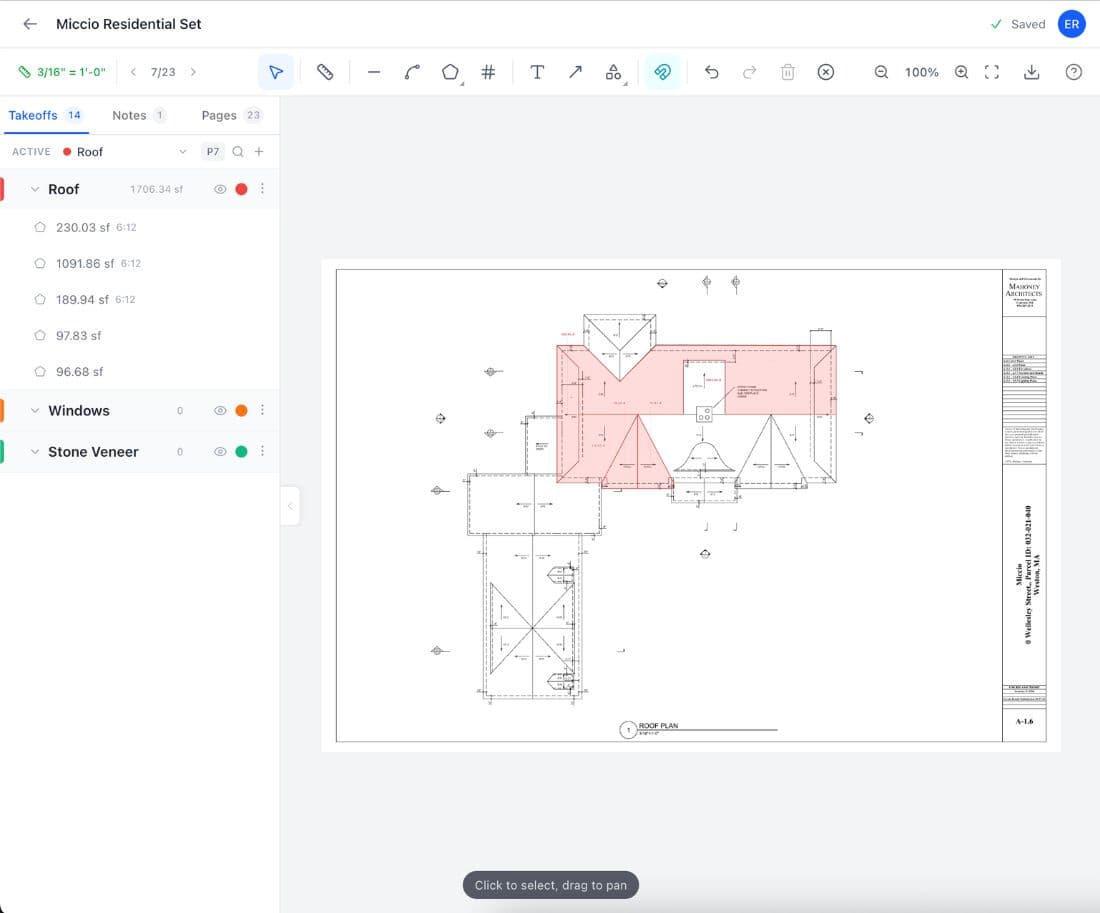
Set the scale using a door width, column grid, or the printed scale on the sheet. Trace each conduit run with the polyline tool, following the routing shown on the plan from panel to junction box to device. Each segment shows its length as you draw. Group runs by circuit number, conduit size, or system.
Count devices, fixtures, and equipment
Box one receptacle symbol and symbol search finds matching copies across the sheets. Confirmed results arrive checked by default with picture previews, so you can review or uncheck any result before adding the checked set as counts in one bulk step. Or mark devices one by one with the count tool. Group counts by device type and floor, with a visible marker on every counted symbol.
Export bill of materials to CSV
Export grouped quantities to CSV. Conduit footage by size and circuit, device counts by type, and fixture counts by catalog number are organized for direct pricing. Import into ConEst, Accubid, Excel, or your estimating spreadsheet. One export feeds the entire material order and labor estimate.
Built for Electrical
Conduit and wire run measurement
Trace conduit paths with the polyline tool from panel to device. Each segment and total run length calculate automatically. Measure home runs, branch circuits, feeders, and fire alarm loops. A 200-foot feeder run with 3 offsets measures in under a minute.
Device and fixture counting
Count every electrical symbol on the plan: duplex receptacles, GFCI receptacles, single-pole switches, 3-way switches, dimmers, junction boxes, panels, disconnects, and every fixture type. Draw a box around one example and symbol search sweeps every sheet for matching copies. Confirmed results are available for review or exclusion before the checked set is bulk-added as counts. Group by device category so your export separates 20-amp duplex receptacles from dedicated circuits.
Circuit and system grouping
Group by circuit number, floor, or system: power, lighting, low voltage, fire alarm, and data, with sub-groups nesting four levels deep so a floor can hold its systems and each system its circuits. Each group gets its own color on the plan. Verify complete coverage visually: if a room has no colored markers, you know it was missed. Each group exports with its own totals.
CSV bill of materials export
Export all quantities to CSV organized by measurement group. Conduit footage, wire runs, device counts, and fixture counts feed directly into ConEst, Accubid, Excel, or any estimating platform. One export builds the material list and labor hour calculation.
Auto scale detection
Most architectural and electrical PDFs have the scale printed on the sheet. Easy Takeoffs reads it automatically. When no scale is printed, calibrate against a known dimension. Each page has its own scale for enlarged details and riser diagrams.
$39 a month, flat
Easy Takeoffs is the cheapest dedicated electrical takeoff tool on the market. Electrical estimating platforms like ConEst, Accubid, and Trimble cost $3,000 to $10,000 a year. PlanSwift is $2,000 a year. STACK starts at $2,988. Easy Takeoffs is $39 a month or $399 a year, with a 14-day free trial and no credit card. Switching from PlanSwift saves $1,532 per estimator per year on monthly billing.
Built-in Electrical Templates
Apply Residential Circuit Run, Residential Device Package, or Commercial Conduit Run templates to your measurement groups for automatic material lists with waste factors and rounding. Adjust properties like cable type, devices per circuit, conduit type, and mounting method to match your job.
Electrical Waste Factors
Industry-standard waste percentages for common electrical materials. Apply these to your measured quantities for accurate ordering.
Typical Waste Factors
Bends consume conduit length: a 90-degree bend in 3/4-inch EMT uses about 6 inches of stick. Offsets, kick bends, and saddle bends each consume more. Cut waste at the end of 10-foot sticks and damaged sticks from bad bends add 5 to 10 percent total.
Each termination needs 2 to 3 feet at panels and 6 to 12 inches at device boxes for stripping and connection. Pull waste from feeding wire into conduit adds another 1 to 2 percent. On long pulls over 100 feet, pulling tension can damage wire, requiring re-pull of the entire circuit.
MC cable is cut to length with less waste than conduit and wire systems. Waste comes from connector tails (3 to 4 inches per connection), end cuts that fall short of the next device, and damaged sections from bending around tight corners. Budget 3 to 7 percent.
Cracked yokes from overtightened screws, defective internal contacts, and field damage during other trades' work waste 2 to 5 percent of devices. GFCIs and AFCIs are more expensive and more fragile, so breakage costs more per unit.
PVC conduit in 10-foot sticks wastes less than EMT because bends are pre-formed fittings, not field bends. Waste comes from cut remnants at the end of runs and cracked sticks from mishandling. Underground runs with straight long runs waste as low as 3 percent.
Fixture breakage during installation is rare but happens with recessed cans, surface-mount troffers, and pendant fixtures. Budget 2 percent for DOA units and field damage. On a 200-fixture commercial job, that is 4 spare fixtures, which is cheap insurance against delays.
Why Electrical Contractors Need Better Takeoffs
Tracing hundreds of conduit runs with a scale wheel
A commercial electrical plan set with 8 floors has hundreds of conduit runs across power and lighting sheets. Each run needs to be traced with a scale wheel from panel to device, the footage recorded, and the tally organized by circuit. This is 10 to 15 hours of tedious measurement on a large project. Miss one 150-foot home run and your bid is light by $300 to $500 in conduit and wire. A polyline tool in Easy Takeoffs traces the run in seconds with exact footage.
Missing devices on dense electrical drawings
Electrical plan sheets are the busiest drawings in a plan set. Receptacle symbols overlap dimension lines, switches hide behind furniture symbols, and junction boxes blend into wall intersections. On a 40,000 square foot commercial floor, undercounting by 15 receptacles is $525 to $750 in devices, boxes, covers, and connectors. A digital count tool with visible markers on the plan prevents missed devices and eliminates double-counting.
Short wire pulls that require re-pulling or splicing
Wire is ordered by the foot from 250 or 500-foot spools. If your conduit run measurement is 5 feet short, the wire pull comes up short at the panel. Splicing inside conduit is a code violation. You have to pull the entire circuit back out and re-pull with a longer piece. On a 200-foot pull with three conductors, that is 600 feet of wasted wire at $0.15 to $0.80 per foot depending on gauge. Accurate run measurement with proper termination allowances prevents this.
Common Electrical Takeoff Mistakes
Measuring conduit runs in plan view without adding vertical rises
Electrical plans show conduit routing in plan view, but the actual run includes vertical drops from ceiling to device height and rises from slab to ceiling. A receptacle at 18 inches above floor with conduit in the ceiling 9 feet up adds about 7.5 feet of vertical conduit to each drop. Ten drops on a circuit add 75 feet of conduit and wire not visible on the plan. Add a standard vertical allowance per device: 8 to 10 feet for wall devices fed from ceiling conduit, 4 feet for devices fed from floor boxes. Include the riser in each circuit's footage calculation.
Counting receptacles without distinguishing types
A duplex 20-amp receptacle costs $2 to $4. A GFCI receptacle costs $12 to $20. An isolated ground receptacle for data rooms costs $25 to $40. A floor box assembly with receptacle runs $80 to $150. Counting all of them as "receptacles" and pricing at the duplex rate means your bid is short every time you hit a GFCI, IG, or floor box. Create separate count groups for each device type: standard duplex, GFCI, IG, floor boxes, USB receptacles, and dedicated circuits. Your export prices each type correctly.
Forgetting home runs from the last device back to the panel
The electrical plan shows conduit runs from device to device along the branch circuit. But the home run from the last device (or first device, depending on routing) back to the panel is often the longest single run on the circuit and may not be clearly drawn. On a commercial floor, home runs can be 100 to 300 feet. Missing a 200-foot home run is $200 in conduit and $300 in wire. Trace every circuit from panel to last device. If the home run routing is not clear on the plan, measure the straight-line distance from the panel to the first device on the circuit and add 20 percent for routing around obstacles.
Not accounting for wire pull conductor count
A 20-amp branch circuit needs 3 conductors: hot, neutral, and ground (12 AWG THHN). A 3-phase circuit needs 4 or 5 conductors. A 200-foot conduit run for a single-phase circuit needs 600 feet of wire (200 times 3). For a 3-phase circuit with ground, it needs 800 feet (200 times 4). Pricing conduit footage but forgetting to multiply by conductor count underestimates wire cost by 60 to 75 percent. For every conduit run in your takeoff, note the number of conductors. Export the conduit footage, then multiply by conductor count in your spreadsheet. Wire cost equals run length times conductors times price per foot.
Assuming all conduit is the same size
Branch circuits use 3/4-inch EMT. Feeders from panels to subpanels use 1-inch to 2-inch conduit. Service entrance may use 3-inch or 4-inch rigid. Pricing everything at 3/4-inch EMT underestimates feeder costs because larger conduit costs 2 to 5 times more per foot and requires more labor to install. A 100-foot feeder run in 2-inch EMT costs $350 in conduit alone versus $80 in 3/4-inch. Group conduit measurements by size. Create separate measurement groups for 3/4-inch branch, 1-inch branch, 1.5-inch feeder, and 2-inch feeder. Price each at its actual per-foot cost.
Electrical Takeoff Pro Tips
Group by system first, then by circuit
Create top-level groups for each electrical system: power, lighting, low voltage, fire alarm, and data/telecom. Within each system, create sub-groups for individual circuits or zones. Your power group might have "Circuit 1 - Kitchen," "Circuit 2 - Living Room," and "Feeder - Panel B." This structure gives you system-level totals for the bid summary and circuit-level detail for the material order. The lighting system total tells you total fixture count and conduit footage for lighting. The power system total gives you device counts and branch circuit footage. Both feed into separate labor categories with different production rates. Color-code each system so the plan view shows complete coverage at a glance. If a room has power markers but no lighting markers, you know the lighting takeoff missed that room.
Add termination allowances per connection point
Wire footage is not the same as conduit footage. Every connection point needs extra wire for stripping, bending, and terminating. At panels, allow 2 to 3 feet per conductor for gutter space, the travel inside the panel to the breaker, and the landing. At each device box, allow 6 to 12 inches per conductor for the device connection. A circuit with 10 devices has 11 connection points (10 devices plus the panel). At 8 inches average per device and 2.5 feet at the panel, that is about 9 feet of extra wire per conductor. On a 3-conductor circuit, that is 27 feet of additional wire. At $0.15 per foot for 12 AWG THHN, it is only $4, but on a 200-circuit commercial job, those termination allowances add up to 5,400 feet of wire at $810. Build termination allowance into your per-circuit calculation formula rather than guessing at the end.
Cross-reference the panel schedule with your device counts
The panel schedule on the electrical plans lists every circuit, its amperage, its breaker type, and the load it serves. Your takeoff device counts and conduit footage should reconcile with the panel schedule. If the schedule shows 42 circuits but your takeoff only measured 38, you missed 4 circuits somewhere. After completing the takeoff, compare your circuit count against the panel schedule. Missing circuits are usually home runs to dedicated equipment (water heaters, HVAC disconnects, garbage disposals) that are small but each requires a full conduit run, wire pull, breaker, and connection. The panel schedule also tells you breaker types. Standard breakers are $5 to $10. AFCI breakers are $30 to $45. GFCI breakers are $35 to $50. Dual-function AFCI/GFCI breakers are $45 to $60. Pricing all 42 breakers at standard rate when 15 are AFCI misses $375 to $525.
Measure lighting and power separately even on the same floor
Most commercial electrical plan sets have separate power and lighting sheets for each floor. Even when they are combined on one sheet, measure them into separate groups. Lighting circuits and power circuits have different conduit routing, different device types, different wire gauges (lighting is often 14 AWG, power is 12 AWG), and different labor production rates. Lighting takeoff is primarily fixture counting and switch-leg conduit. Power takeoff is primarily receptacle counting and branch circuit conduit. Mixing them means your material quantities cannot be priced accurately because the cost per foot of 14 AWG wire in 1/2-inch EMT is very different from 12 AWG in 3/4-inch EMT. Separate groups also let you assign lighting to the lighting subcontractor and power to the power crew if your company divides the scope that way.
Flag low voltage and fire alarm as separate scopes
Low voltage (data, telecom, security cameras) and fire alarm are often on the same electrical plan set but may be subcontracted to specialty firms. Measure them into their own groups from the start. If you are the GC verifying sub bids, your low voltage group total should match the low voltage sub's quantity. If it does not, one of you missed something. Fire alarm is particularly scope-sensitive. A commercial fire alarm system has pull stations, horn/strobes, smoke detectors, duct detectors, and a fire alarm control panel, all connected by dedicated fire alarm cable. The cable footage comes from the loop routing on the fire alarm plan, measured the same way as conduit. Missing one floor of fire alarm loop can be 500 to 1,000 feet of cable and 20 to 30 devices at $15 to $50 each. Keep low voltage and fire alarm in separate groups so the scope is clear, measurable, and comparable against subcontractor bids.
Electrical Takeoff Questions
Start Your Construction Takeoff Today
Upload your plans, measure your quantities, and export the results. Try the full software for 14 days, then choose $39 a month or $399 a year.