Plumbing Takeoff Software
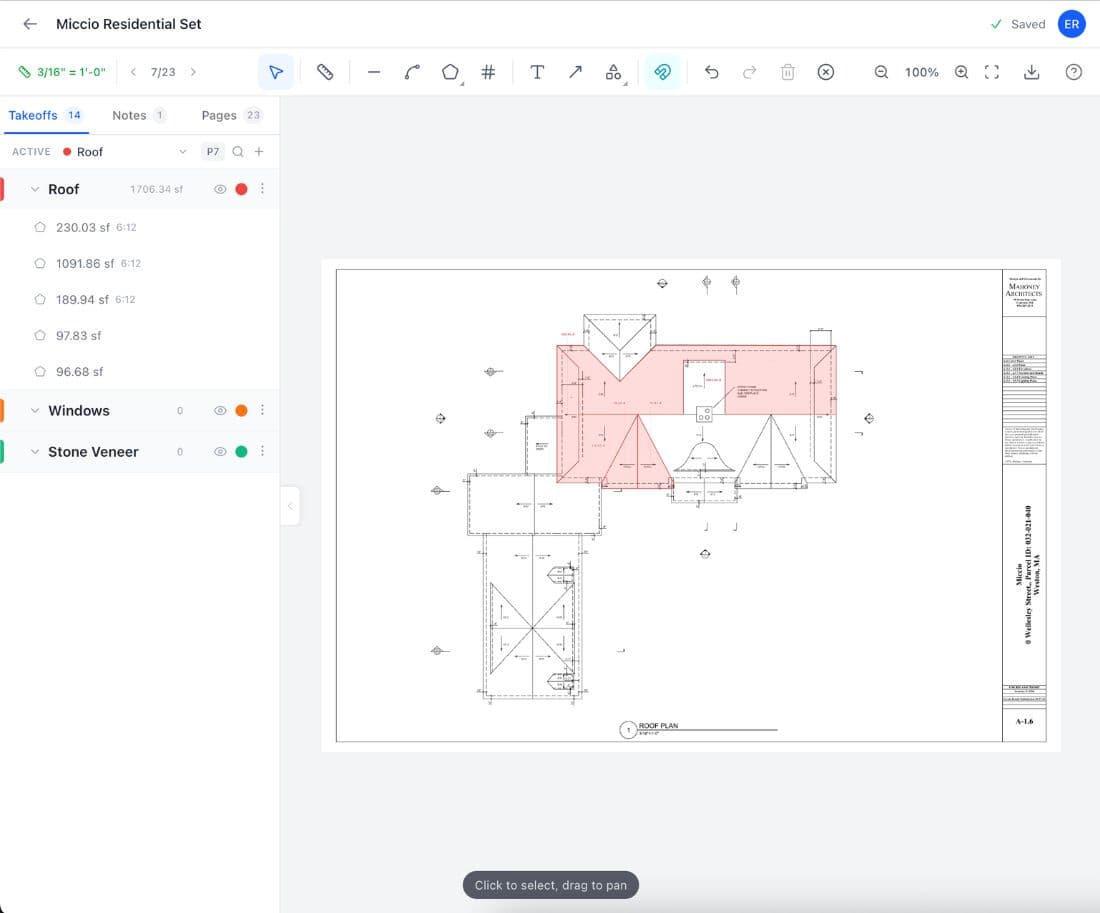
Trace supply, waste, and vent pipe runs from PDF mechanical plans with built-in material templates. Count every fixture rough-in. Group by system, diameter, and floor. Export organized material quantities. $39 a month per individual account.
Plumbing Takeoffs, Simplified
A plumbing takeoff is pipe linear footage by diameter and material (PEX, copper, PVC, cast iron), fixture rough-in counts, and equipment connections, separated by system: supply, drain-waste-vent, gas, fire sprinkler. A plumbing rough-in on a 3-story apartment building has 60 fixture units across kitchens, bathrooms, and laundry rooms. Each unit needs hot supply, cold supply, waste, and vent connections. Miss 200 feet of 3/4-inch copper supply pipe and you are short $600 to $800 in pipe plus $200 in fittings, and your crew is waiting while you drive to the supply house. Miss 5 toilet rough-ins on the third floor and you are short 5 closet flanges, 5 supply stops, and 5 wax rings. Small items individually, but collectively it is a half-day delay for your rough-in crew. On a $200,000 plumbing contract with 10 percent margin, a 3 percent takeoff error wipes out a third of the profit. Easy Takeoffs is plumbing bid software for $39 a month that lets you trace pipe runs on PDF mechanical plans using the polyline tool and count every fixture with the count tool. Group measurements by pipe type: hot supply, cold supply, waste, and vent. Or group by diameter: 1/2-inch, 3/4-inch, 1-inch supply; 1.5-inch, 2-inch, 3-inch, 4-inch waste. Export everything to CSV organized by group for pricing and ordering. Try every feature free for 14 days, no credit card, no desktop software to install. Built-in plumbing templates for Plumbing Fixture Rough-In, Fire Sprinkler Pipe, and Fire Sprinkler Heads generate material lists from your measurements. The Plumbing Fixture Rough-In template calculates supply pipe, drain pipe, vent pipe, valves, and fittings per fixture based on fixture type and average run lengths. The Fire Sprinkler Pipe template handles pipe sticks, fittings, hangers, and couplings. The Fire Sprinkler Heads template calculates heads, escutcheons, and wrench quantities by head type.
Every Measurement Type
Areas, lines, counts, angles, and true curves, plus symbol search
Snap to Walls & Corners
Cursor locks to lines, corners, midpoints, and edges
Auto Scale Detection
Reads each sheet's scale; one tap confirms, one run sets every page
$39 a month
14-day free trial, no credit card, cancel any time
Any Device
Browser-based on Mac, Windows, tablet, or phone
What Is a Plumbing Takeoff?
A plumbing takeoff is the process of measuring pipe run lengths by type and diameter, counting every fixture and appurtenance, and building a bill of materials from plumbing construction drawings. Plumbing plans (P-sheets) show pipe routing in plan view with supply lines, waste lines, vent lines, and fixture symbols. Riser diagrams show vertical pipe runs between floors. Isometric details show three-dimensional pipe routing at complex fixtures. The takeoff produces three categories of quantities. First, pipe footage by material and diameter: copper or PEX for supply, PVC or ABS or cast iron for waste and vent, with separate totals for each diameter. Second, fixture counts by type: water closets, lavatories, kitchen sinks, bathtubs, showers, floor drains, hose bibs, cleanouts, water heaters, and specialty items. Third, fitting counts derived from pipe routing: each direction change needs an elbow, each branch needs a tee, and each connection needs a coupling or adapter. Valve counts come from the fixture count and the system design: each fixture needs supply stops, and the main system needs gate or ball valves at branches. The bill of materials feeds into pricing using labor unit rates per fixture and per foot of pipe.
How to Do a Plumbing Takeoff
Upload plumbing plans and risers
Drop your PDF plumbing plans into Easy Takeoffs. Floor-level plumbing plans, riser diagrams, isometric details, and fixture schedules all live in one project. Navigate between P-sheets for each floor and the riser diagram using the page selector.
Trace pipe runs by system and diameter
Use the polyline tool to trace supply, waste, and vent pipe runs on each floor plan. Create measurement groups by system and diameter: "3/4 CU Hot Supply," "3/4 CU Cold Supply," "2-inch PVC Waste," "1.5-inch PVC Vent." Each segment shows its length as you draw and the group tracks cumulative footage.
Count fixtures and appurtenances
Use the count tool to mark every fixture location: water closets, lavatories, kitchen sinks, tub/showers, floor drains, hose bibs, cleanouts, and water heaters. Group by fixture type. Count valves, backflow preventers, and expansion tanks separately.
Export pipe footage and fixture counts
Export all measurements to CSV. Pipe footage by system and diameter, fixture counts by type, and valve counts feed directly into your estimating spreadsheet. Convert footage to pipe sticks, calculate fittings from direction changes, and build the complete material order.
Built for Plumbing
Pipe run measurement by system
Trace supply mains, branch lines, waste stacks, horizontal waste runs, and vent lines with the polyline tool. Group by material and diameter so your export separates 3/4-inch copper supply from 2-inch PVC waste from 1.5-inch vent. Each group tracks its own running footage total.
Fixture and valve counting
Count every fixture: water closets, lavatories, kitchen sinks, tub/showers, floor drains, hose bibs, cleanouts, and water heaters. Box one fixture symbol and symbol search returns confirmed matches across the sheets, checked by default for optional review before bulk addition, or click items one by one. Each fixture type gets its own group, and supply stops, gate valves, ball valves, and check valves count separately for the valve order.
System and floor grouping
Group by pipe type (hot supply, cold supply, waste, vent), by diameter, or by floor. On a multi-story building, floor-level grouping lets you stage pipe material per floor. System grouping lets you order copper supply and PVC waste from different suppliers.
CSV material export
Export pipe footage and fixture counts to CSV organized by group. Import into your estimating spreadsheet, apply labor units per foot and per fixture, and generate the bid. One export feeds both the material order and the labor calculation.
Auto scale detection
Most mechanical PDFs have the scale printed on the sheet. Easy Takeoffs reads it automatically. Plumbing plans are typically at 1/4 inch or 1/8 inch scale. Riser diagrams and isometric details may be at different scales and calibrate independently.
$39 a month, flat
Easy Takeoffs is the cheapest dedicated plumbing takeoff tool on the market. Plumbing estimating platforms from FastPIPE, QuoteSoft, and McCormick cost $3,000 or more a year. PlanSwift is $2,000 a year. STACK starts at $2,988. Easy Takeoffs is $39 a month or $399 a year, with a 14-day free trial and no credit card. Switching from PlanSwift saves $1,532 per estimator per year on monthly billing.
Built-in Plumbing Templates
Apply Plumbing Fixture Rough-In, Fire Sprinkler Pipe, or Fire Sprinkler Heads templates to your measurement groups for automatic material lists with waste factors and rounding. Adjust properties like fixture type, average supply run, drain run, pipe size, or head type to match your job.
Plumbing Waste Factors
Industry-standard waste percentages for common plumbing materials. Apply these to your measured quantities for accurate ordering.
Typical Waste Factors
Each fitting connection consumes pipe inside the hub: a 3/4-inch copper elbow inserts 5/8 inch on each side. On a run with 15 fittings, hub depth alone adds nearly 2 feet. Cut waste at the end of 10-foot sticks and damaged sections from bad solder joints add another 3 to 5 percent.
PEX flexibility reduces waste because it routes around obstacles without fittings. Waste comes from termination tails at manifolds (6 to 12 inches each), crimped sections that need to be cut off and re-done, and coil memory at the start of each roll. Budget 3 to 7 percent.
Hub-and-spigot joints consume pipe length inside each fitting. A 3-inch PVC sanitary tee inserts about 1.5 inches on each port. Cut remnants at the end of 10 or 20 foot sticks and cracked sections add up. Waste increases with diameter because larger sticks are heavier and more prone to handling damage.
Cast iron is heavy, brittle, and breaks if dropped. Each no-hub coupling needs 2 to 3 inches of clean pipe on each side for the neoprene gasket to seal. Cut waste from 5 and 10 foot sticks and breakage during cutting or handling push waste to 8 to 12 percent.
CPVC is rigid and cracks easily in cold weather. Solvent-weld joints consume pipe inside the fitting hub, similar to PVC waste. Cracked sections from overtightened hangers or accidental impact during other trades' work add to the waste.
Fitting waste is low because each fitting is a discrete item. Waste comes from defective fittings out of the box, wrong sizes pulled from the truck, and damaged fittings from dropped boxes. Budget 2 to 5 percent on quantity orders.
Why Plumbing Contractors Need Better Takeoffs
Three pipe systems on one crowded drawing
Plumbing plans overlay hot supply, cold supply, waste, and vent lines on the same sheet. Tracing each system separately with a scale wheel on paper means making four passes through every room, highlighting each system in a different color. Miss a 30-foot waste run behind the bathtub and you are short $25 in PVC pipe, $40 in fittings, and an hour of labor to install it after the wall is closed. Color-coded measurement groups in Easy Takeoffs let you trace each system in one pass with visual separation.
Missing fixture rough-ins on multi-story buildings
A 4-story apartment building with 16 units has 80 to 120 fixture rough-ins spread across plumbing plans for each floor. Every missed fixture is a missing closet flange, supply stops, trap, and the associated pipe connections. On a project where rough-in labor runs $350 to $600 per fixture, missing 5 fixtures is $1,750 to $3,000 in unbudgeted work. A digital count tool with markers on the plan ensures every fixture is captured floor by floor.
Fitting quantities that multiply faster than expected
A 100-foot run of 3/4-inch copper supply pipe with 12 direction changes needs 12 elbows at $3 to $6 each, plus tees at branches, plus couplings. The fittings alone add $50 to $100 to a single run. On a whole-house repipe with 30 runs, fitting costs can exceed the pipe cost. Accurate polyline traces that show every direction change give you a reliable fitting count instead of a guess.
Common Plumbing Takeoff Mistakes
Measuring pipe runs in plan view without vertical drops
Plumbing plans show pipe routing in plan view. But supply pipes run overhead in the ceiling and drop down to each fixture. A kitchen sink 3 feet above the floor served by overhead supply has about 6 feet of vertical pipe per drop (3 feet from ceiling to fixture times 2 for hot and cold). Ten fixtures with overhead supply add 60 feet of vertical pipe not visible on the plan view. Add a vertical allowance per fixture based on the installation method: 5 to 8 feet per fixture for overhead supply drops, 3 to 5 feet for underslab waste connections. Review the riser diagram for exact vertical dimensions.
Counting fixtures without separating by type
A water closet rough-in needs a 3-inch or 4-inch waste connection, a closet flange, a 3/8-inch supply stop, and a wax ring. A lavatory needs 1.5-inch waste, a P-trap, two supply stops, and a pop-up drain. Counting both as "fixtures" and applying one average cost means you under-price toilets and over-price lavatories. Create separate count groups for each fixture type. Your export should show 12 water closets, 14 lavatories, 4 kitchen sinks, 6 tub/showers, 2 floor drains, and 1 water heater. Each type has its own rough-in labor rate and material kit.
Ignoring pipe size changes along runs
Supply mains start at 1 inch or 1.25 inch near the water entry and reduce to 3/4 inch at branch lines and 1/2 inch at fixture connections. Waste mains run 4 inch at the building drain and reduce to 3 inch, 2 inch, and 1.5 inch at individual fixtures. Measuring an entire run at one diameter overestimates expensive large pipe and underestimates total fittings because each size reduction needs a reducer coupling. Create measurement groups by diameter. Trace each pipe section at its actual diameter. When the pipe reduces from 1 inch to 3/4 inch, end the 1-inch trace and start a new trace in the 3/4-inch group.
Forgetting vent pipe footage
Every fixture trap needs a vent to prevent siphoning. Vent pipes run from the fixture trap upward through walls and connect to the vent stack, which exits through the roof. Vent footage can equal 40 to 60 percent of the waste pipe footage on a typical residential system. Skipping vent measurement means your PVC order is short and your bid underestimates labor. Trace vent runs the same way you trace waste runs. Create a separate measurement group for vents. On the plan view, vents are typically shown as dashed lines. Follow them from each fixture to the vent stack connection.
Not accounting for insulation on hot supply lines
Energy codes in most jurisdictions require insulation on hot water supply lines, especially the first 5 to 8 feet from the water heater and all recirculation loops. Pipe insulation adds $1 to $3 per linear foot for 3/4-inch fiberglass or foam. On a residential system with 200 feet of insulated hot supply, that is $200 to $600 in insulation material not in the bid. Measure hot supply runs in their own group. The hot supply footage total gives you the insulation footage directly. Check the energy code for your jurisdiction to determine which runs require insulation.
Plumbing Takeoff Pro Tips
Group by material and diameter for accurate ordering
Create measurement groups that match how you order pipe: "3/4 CU Type L Hot," "3/4 CU Type L Cold," "1/2 CU Type L Hot," "2-inch PVC DWV Waste," "1.5-inch PVC DWV Vent," "4-inch PVC DWV Building Drain." Your export totals convert directly to pipe sticks and coils without resorting. This structure also reveals the material cost breakdown. Copper at $4 to $8 per foot for 3/4-inch type L is the most expensive material in a residential plumbing system. If your copper group shows 400 feet, that is $1,600 to $3,200 in copper alone. PVC waste at $1 to $3 per foot is much cheaper but typically involves more total footage. For PEX systems using manifold distribution, measure each home run from the manifold to the fixture separately. PEX is ordered in rolls (100 or 300 feet), so sum the total footage by diameter and divide by roll length to get your coil count.
Use the riser diagram for vertical pipe and the plan for horizontal
Plumbing plans show horizontal routing but not vertical runs. The riser diagram shows vertical pipe runs between floors, waste stacks, vent stacks, and the relationship between fixtures on different floors. Open both sheets in your project and measure from each one. On the plan view, trace horizontal supply, waste, and vent runs per floor. On the riser diagram, measure vertical stack heights and riser footage between floors. A 3-story building with a 4-inch waste stack from the basement to the roof might have 35 feet of vertical pipe not visible on any single floor plan. Combine the horizontal and vertical measurements in the same group by diameter. The total gives you the full pipe order for that material and size.
Count fittings from direction changes in the polyline
Every click point in a polyline trace represents a direction change in the pipe run. Count the clicks minus one to get the number of elbows in that run. Tees occur where branches split off from mains. Couplings occur at pipe joins that do not change direction. For a run with 8 direction changes, budget 8 elbows. For each branch off a main, budget one tee. For every 10 feet of straight run, budget one coupling (since sticks come in 10-foot lengths). Reducer couplings go where pipe diameter changes. This method gives you a reliable fitting estimate directly from the takeoff. The alternative, which is guessing a fitting factor like "20 percent of pipe cost," routinely underestimates fittings on complex runs and overestimates them on long straight runs.
Verify fixture counts against the plumbing fixture schedule
The plumbing fixture schedule in the specifications lists every fixture by type, manufacturer, model number, and quantity. Your takeoff fixture counts from the plan should match the schedule. If they do not, submit an RFI before bidding. The schedule is the contractual quantity. If the plan shows 14 lavatories but the schedule lists 12, the engineer needs to clarify. Bidding 14 when the contract says 12 means you are over on material. Bidding 12 when the plan shows 14 means you miss two rough-ins. For commercial projects, the fixture schedule also determines the fixture unit count for pipe sizing. If your takeoff reveals a discrepancy between the schedule and the plan, it may affect pipe sizing calculations upstream.
Add 10 feet per fixture for rough-in connections
Plan-view pipe measurements capture the horizontal routing from the main to the general fixture area. But the last 5 to 10 feet of pipe at each fixture, including the stub-out through the wall, the connection to the supply stop or trap, and the vertical drop from the ceiling or riser, is not clearly shown on the plan. Budget 8 to 12 feet of supply pipe per fixture (hot plus cold combined) and 5 to 8 feet of waste and vent pipe per fixture for the final connections. On a 15-fixture residential system, that is 120 to 180 feet of supply and 75 to 120 feet of waste/vent not visible in the plan-view traces. Add this rough-in allowance to your measured footage before applying the waste factor. It is a real material cost that experienced plumbers include and new estimators miss.
Plumbing Takeoff Questions
Start Your Construction Takeoff Today
Upload your plans, measure your quantities, and export the results. Try the full software for 14 days, then choose $39 a month or $399 a year.