Material Takeoff Templates
for Every Trade
Measure the plan and the material list writes itself. 44 built-in templates convert your measurements into sheets, yards, gallons, and sticks, with waste factors you can see and change. Build your own with custom formulas, or borrow from the community library.
From Measurement to Material List
Apply a Template or Tool Set
Attach a built-in, community, or custom template to a measurement group. Or apply one of the 14 trade tool sets and get every group a trade needs, colored and pre-wired, in one click.
Dial In the Properties
Set stud spacing, slab thickness, tile size, board dimensions: whatever the template exposes. Waste is visible per material and yours to change.
Measure the Plan
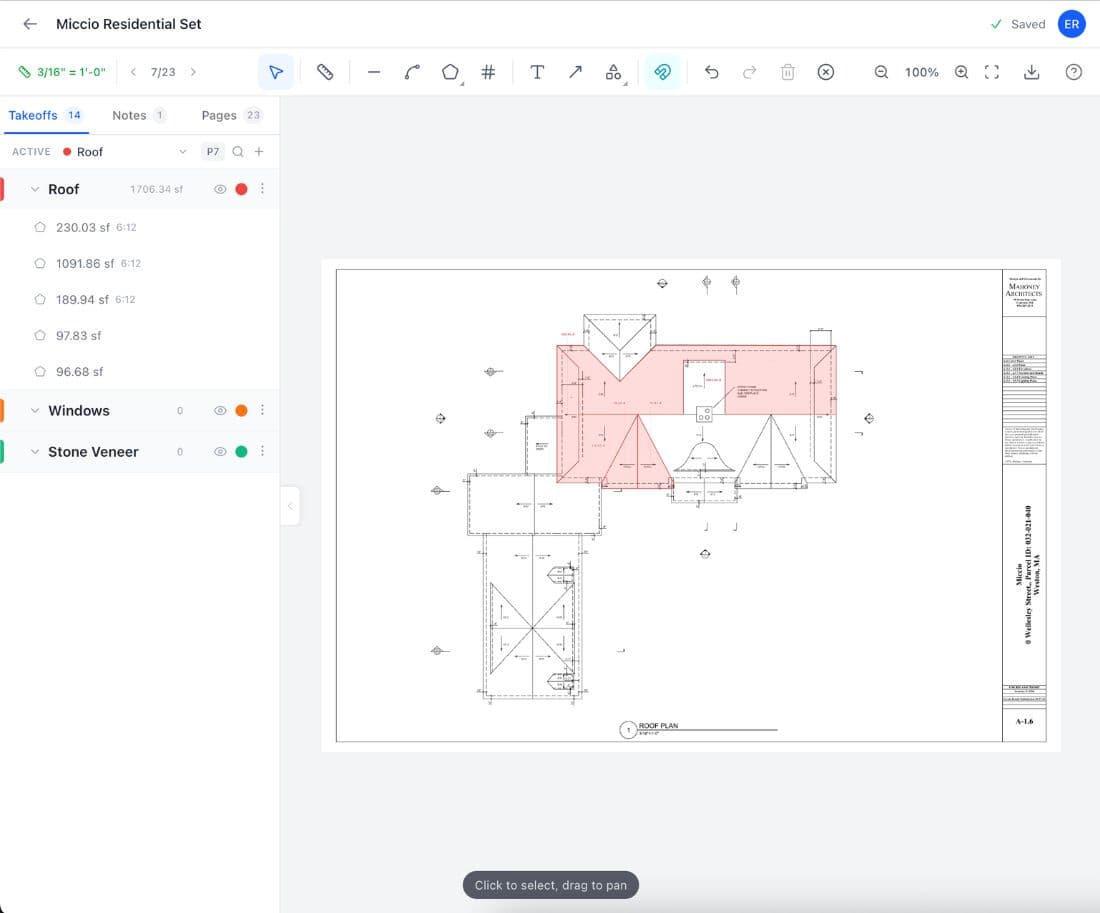
Draw into the group and watch quantities update live beside the plan. Self-measuring assemblies lay out sub-groups for each quantity they need.
Export the Material List
The CSV carries a materials section with applied waste, ready for your supplier or estimate. The annotated PDF ends with a Takeoff Summary of group totals and materials.
The Takeoff Is Not Done Until It Is an Order
Square footage does not go on a purchase order. Sheets do. Yards do. Gallons, squares, sticks, and bundles do. The gap between what you measured and what you can buy is where most of the after-hours arithmetic lives, and it is where a slipped decimal quietly becomes a short delivery or a padded bid.
Templates close that gap while you measure. Attach one to a group and the material math runs live: change a wall height and the sheet count moves, tighten a waste factor and the order shrinks, remeasure after an addendum and everything downstream is already current. The group workspace keeps the running materials beside the plan, so you watch the order build as you draw.
And because every formula, property, and waste percentage is visible, the number you hand a supplier is one you can defend line by line, which is exactly what a bid review asks you to do.
Takeoff Tools Built for Every Trade
From flooring to full ground up builds, Easy Takeoffs handles the measurements your trade demands. Built for every trade, $39 a month.
Everything the Template System Gives You
44 Built-In Templates
Concrete slabs, foundation walls, strip footings, and CMU block. Wood and metal stud framing. Drywall walls and ceilings, acoustical ceilings, batt, blown-in, and spray foam insulation. Shingle, asphalt, and flat membrane roofing, siding, and gutters. Interior and exterior paint. Tile, carpet, and hardwood flooring. Residential circuits and device packages, commercial conduit, low-voltage cable, plumbing rough-in, HVAC duct, fencing, landscaping, paving, and demo. Every template ships in the subscription; none are sold separately.
Properties That Match the Job
A template is only useful if it calculates your spec, not a generic one. Each template exposes the properties that drive the math: stud spacing on framing, slab thickness on concrete, board size on drywall, tile size and pattern on flooring. Change a property and every material recalculates instantly, on screen, in the sidebar, and in the export.
Waste You Can See and Control
Every material shows the waste percentage its math is using, right next to the quantity. Defaults follow your property choices where the trade calls for it (a herringbone tile pattern wastes more than straight lay), and any edit you make replaces the default outright. No hidden padding, no mystery multipliers: the number on the order is one you can explain.
Assemblies That Measure Themselves
A roof is not one quantity, it is area plus ridge, valley, and eave. Templates built for that lay out a colored sub-group for each quantity they need, a built-in checklist of what to trace. Measure into those groups and the numbers flow straight into the template math, updating live as the drawing changes. Any quantity can stay manual when you would rather type it.
Your Own Formulas
When your work is not on the shelf, build it. The custom template editor turns the quantities a group measures (area, length, count, perimeter, volume, wall area) into any material list you can write a formula for, with units, rounding, and default waste per material. Custom templates live on your account and work in every project.
A Community That Shares Its Homework
The community library holds templates other contractors have built and shared, reviewed before they are published. Browse by trade, apply one, and adjust its properties like any built-in. If you have dialed in a template for your niche, submit it and save the next estimator the setup.
Where Material Math Goes Wrong by Hand
The Second Job After the Takeoff
You finish measuring and the real work starts: turning 2,400 square feet of wall into sheets, compound, tape, and screws with a calculator and a legal pad. Every conversion is a chance to slip a decimal, and every change to the drawing means doing the chain again. The measuring took an hour. The arithmetic took the evening.
The Spreadsheet Only One Person Understands
Most shops have one: the estimating workbook with fifteen years of formulas, three of which still matter and none of which are documented. It works until the person who built it is on vacation during bid week, or until a dragged cell quietly breaks a formula and nobody notices until the material order lands short.
Waste Factors from Folklore
Ten percent because that is what the last guy used. Fifteen because the job before ran short. When waste lives in your head or a buried spreadsheet cell, it never adjusts to the actual work: the cut-heavy room, the diagonal pattern, the roof with six valleys. Padding everything the same is how bids come in high on easy work and short on hard work.
Starting from Zero Every Project
New project, blank document, and twenty minutes of creating the same groups you always create: one per wall type, one per fixture class, colors that make sense, templates attached. Setup is not estimating, but it eats estimating time, every single project.
Material Template Questions
Start Your Construction Takeoff Today
Upload your plans, measure your quantities, and export the results. Try the full software for 14 days, then choose $39 a month or $399 a year.